
Why was Akira colored for America?
A black-and-white manga that taught American comics how to color.
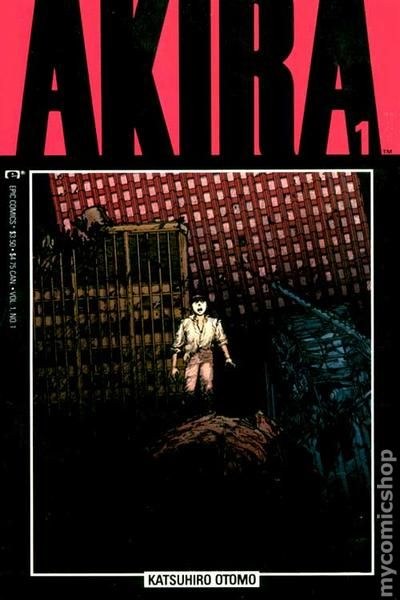
When Marvel’s Epic Comics brought Akira to America in 1988, manga was nearly unknown there, and the standard American comic was in color and read left to right. So the Japanese pages were flopped, re-lettered, and colored, a transformation Otomo approved down to choosing the colorist himself: Steve Oliff, introduced to him by Epic editor Archie Goodwin.
Otomo sent Oliff illustrations colored with markers as samples, and film slides as reference. Oliff has recalled that Otomo visited him in Point Arena, California, and worked alongside him for several days; after the first five or six issues, he was given free rein. The job ran, with interruptions, from 1988 to 1994, across 38 issues that ended in 1995.
HOW THE COLOR WAS MADE
Paint first, computer secondThe hand-painted guides
Oliff colored the pages the old way first: by hand, in watercolor and felt pen, over printed copies of Otomo’s linework, at a small 7 by 10.5 inch image size. Surviving guides, sold today as production art, show every page treated as a small painting.
The digital separations
His company Olyoptics then rendered those guides as computer color separations, working on an IBM 286 with a Targa graphics board and software so unstable it needed a homemade heat sink on its math coprocessor, by the team’s own account. Akira is credited as the first mass-market comic colored this way, and the industry adopted the method behind it.
The awards
Oliff won Harvey Awards for Best Colorist three years running, 1990 to 1992, and the very first Eisner Award for Best Coloring in 1992. The colorist had never been the headline credit on a comic before; on Akira, he was.
THE COLLECTIONS THAT NEVER FINISHED
A color ending that lives in single issuesSlowed by the source
Epic’s edition kept stalling for a revealing reason: it was translated from the Japanese collected volumes, and Otomo was retouching the art for those volumes, so the color edition had to wait on the revisions. The final eight issues took years.
1993: the collections stop
Marvel planned thirteen paperback collections and, with Graphitti Designs, six limited hardcovers. The line ceased in 1993 with three paperbacks and the sixth hardcover unpublished. The result: the color version of Akira’s ending exists only in the original single issues.
The British exception
British publisher Reed began issuing complete full-color volumes in 1994, and Japan later re-imported the color edition as its own sets. America, which commissioned the color, is the one place that never got it whole in book form.