
From the Library: covers, censuses, and editions, documented. Browse the Library →
SOJ Akira · The Text
← Back to the Library

What changed between Akira in the magazine and in the books?

The book is not the magazine with a cover on. Otomo kept working.

It is tempting to treat a collected volume as the magazine chapters in a binding. For Akira, the record says otherwise, three times over. The clearest early witness is the English edition: Epic Comics translated from the collected volumes rather than the magazine, and its publication suffered significant delays toward the end because Otomo was still retouching the artwork for those volumes. The color Akira of the early 1990s was late, in part, because its author would not stop revising the black-and-white one.

The second witness is Akira Club (1995), which exists largely to print what the books displaced: the chapters’ title pages as they ran in Young Magazine, and the test designs for the covers. Paratext is where revision shows first, and Otomo archived it himself.
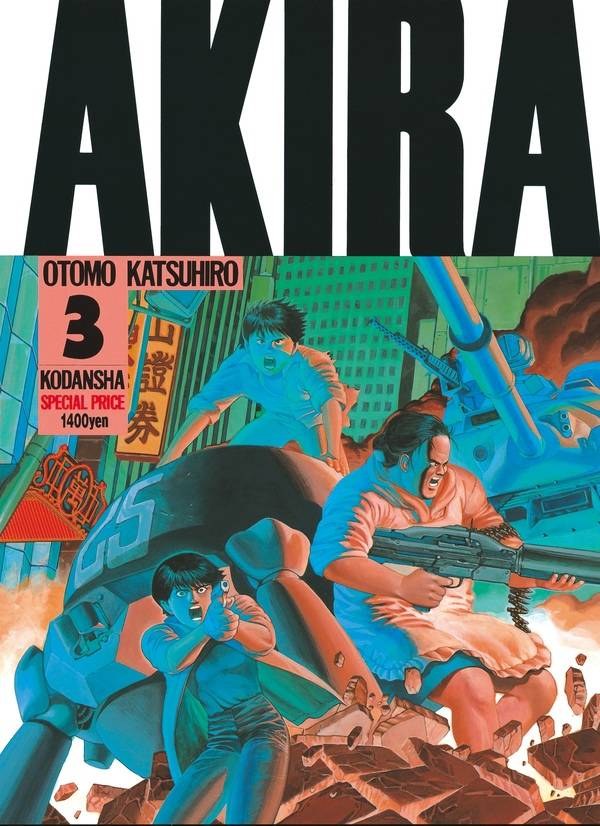
Cover of Akira volume 3 (Kodansha)
THE BOOK VERSIONVolume 3 in book form. Otomo redrew and reworked pages between the magazine chapters and the collected editions.

THE PUBLISHER’S OWN LIST

What the restoration had to undo
The Complete Works brief
When Kodansha launched the Complete Works edition of the manga in August 2024, it described the aim as returning “to the original serialized version as much as possible,” restoring deleted title pages, and undoing a specific catalogue of changes: additions, corrections, deletions, replacements, reordering of pages and panels, additional finishing, and newly drawn content. Read backwards, that list is the map of everything the tankobon did to the magazine text.
A different physical text
The restoration also changes the object: the Complete Works volumes are a touch smaller than the B5 tankobon and printed on markedly better paper, where the originals’ pulpy stock yellows with age. Magazine text, book paper: the 2020s edition is a hybrid neither generation produced.

THE HONEST LIMIT

What nobody has published
No panel-by-panel change log
Neither Kodansha nor Otomo has issued a scene-by-scene account of the retouching, and this page does not invent one. The documented record is the three witnesses above: an English edition delayed by revisions, an art book preserving the displaced pieces, and a publisher’s restoration brief that names the categories of change.
Why collectors care
It means “the manga” is two texts: the one Young Magazine’s readers followed from 1982 to 1990, and the one the six famous volumes fixed in 1984 to 1993. First printings of the volumes are printings of the revised text. The magazine version, for four decades, existed complete only in back issues, until the Complete Works began reprinting it.
First printings → Why was Akira colored? → More from the Library →
MORE FROM THE AKIRA ARCHIVE →
One shelf of eighty-two in the Library. Browse them all →

THE FIRST WORD

New pages and new pieces, first.