
The History of Banjo-Kazooie
Banjo-Kazooie reached North America on June 29, 1998, Europe on July 17, and Japan on December 6, 1998 as Banjo to Kazooie no Daibouken. Designed by Gregg Mayles with art by Steve Mayles and music by Grant Kirkhope, it sent a bear and a bird through nine nonlinear worlds after 100 Jiggies and 900 musical notes, and sold over three million copies. Critics of the day said, in print, that it surpassed the game it was chasing.
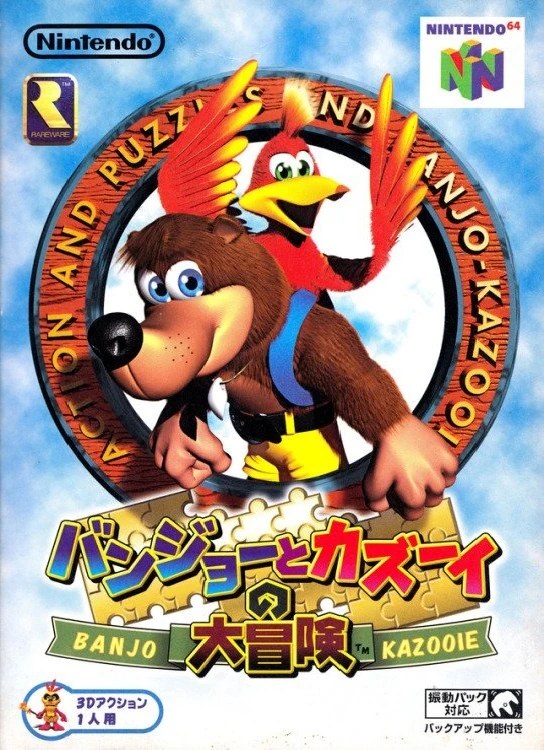
THE TWO COVERS
The adventure, renamed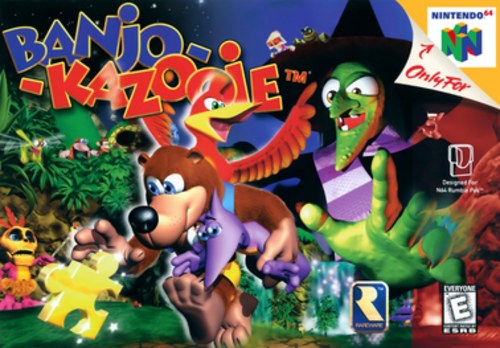
THE GAME INSIDE THE GAME
Project DreamBanjo-Kazooie began as something else entirely: Project Dream, a Super Nintendo role-playing game about a boy, from the team behind Rare's 1995 platformer sequel. The boy was replaced by a rabbit, the rabbit lasted two or three days, and a bear took the lead. The project moved to the Nintendo 64 and went 2.5D, until the team saw a really, really early showing of Super Mario 64 and understood that the ground had moved. Rare scrapped the shape of the game and went full 3D.
Work on the game players know started in March 1997; the team grew from ten to fifteen people, the schedule ran seventeen months, and staff weeks of at least eighty hours are part of the record. Gregg Mayles aimed deliberately away from Mario's reflex platforming toward exploration, partly as an answer to the camera problems of the moment. Kazooie herself is a design fix with a personality: Banjo needed a double jump and faster legs, the abilities wanted a source, and the source became a sarcastic bird in his backpack, named after the kazoo, in Mayles's words an annoying instrument. Nobody in the game truly speaks. The cast mumbles over text, because real voices, the team judged, could ruin the player's perception of the characters.
THE MUSIC
One tune, every altitudeBanjo-Kazooie was the first game where Grant Kirkhope carried the entire audio alone, and he built its signature trick: vertical remixing, one composition whose layers fade in and out as the player moves, so the same tune plays above ground and underwater in different arrangements without ever stopping. Kirkhope took the style's cue from Danny Elfman's Beetlejuice score, dark chords kept comic by rhythm, and the haunted chords of Mad Monster Mansion descend from Elfman's 1989 Batman cathedral progression. Reviewers treated the soundtrack as a headline feature, and the technique became a standard tool of game scoring.
The reception matched the ambition: a 92 on Metacritic, the Academy of Interactive Arts and Sciences awards for Console Action Game of the Year and Outstanding Achievement in Art and Graphics, and a running critical argument about whether Rare had out-Marioed Mario. Japan was cooler: about 117,000 copies by the end of 1998 and just over 405,000 by March 2003, respectable, but a fraction of the Western run. The game ends on a tease, two coloured eggs and an Ice Key behind glass, and that tease became the most famous unfinished idea on the console. It has its own page on this shelf.