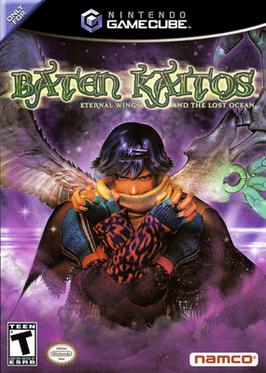
The History of Baten Kaitos
Baten Kaitos: Eternal Wings and the Lost Ocean (GameCube, 2003) was developed by Monolith Soft and tri-Crescendo and published by Namco. It was directed by Yasuyuki Honne and Hiroya Hatsushiba, produced by Tadashi Nomura, written by Masato Kato of Chrono Cross, and scored by Motoi Sakuraba. Humanity lives on floating continents above a lost ocean, and everything in its world, weapons, food, photographs, can be captured into magical cards called Magnus. The player is not Kalas, the one winged hero. The player is his guardian spirit, addressed by name, and the cast can hear you.
THE MAKING
Two pitches, one game, a console with no RPGsThe concept dates to 2001, with full development beginning about six months later: roughly fifty staff over eighteen months, two years from inception to finish. Monolith Soft, founded by Xenogears staff and then known for Xenosaga, ran the project with its younger staff; tri-Crescendo, a sound studio making its first full game, built the battle system and the sound. The pairing was Namco's suggestion, after both companies pitched similar games. Kato was chosen, the team has said, for writing passionate dialogue that does not sound weird or embarrassing, and the floating islands and the action leaning battle were set early.
The platform was the point. The GameCube was chosen, on the record, because its library lacked Japanese RPGs: the team wanted to offer a true RPG to its userbase and establish a franchise for the system. The name is the star Baten Kaitos in the Cetus constellation, chosen as a symbol of rich nature and the grand world the team wanted, and as a deliberate anti-Xenosaga, a sky and nature game against a space opera. Honne pushed the art toward 3D characters over hand drawn 2D backgrounds to spend the GameCube's power on detail, and talked Namco into licensing The Tower of Druaga for an 8-bit segment; in Japan, a playable Tower of Druaga disc was the pre-order bonus. Sakuraba composed over sixty songs and performed on every track.
THE DESIGN
Magnus: the inventory is the battle systemOver a thousand Magnus exist. Blank cards capture the essence of objects in the world; food and medicine heal, weapons and armor equip, and battle cards build each character's deck. Magnus age in real time: milk curdles into cheese, a ripe banana rots, and a camera Magnus takes photographs in battle that sell for money. Combat mixes turn based structure with timed card play: hands are dealt from the deck, and spirit numbers reward pairs and runs, 1-2-3-4, the poker showing through the RPG. Certain cards combine mid battle, cucumber and honey becoming a honeydew melon.
Experience is not spent where it is earned. It is applied at churches, reached through blue flowers, where the party prays to level up or class up and widen the deck. The guardian spirit framing runs through everything: answer Kalas's questions the way he would, and the bond strengthens, and the battles feel it.
THE EDITIONS
One GameCube original, a long wait, a remasterTHE RECEPTION
80, with the dissent aimed at the voicesTHE LEGACY
The goal was 500,000. It was not close.Namco set a worldwide sales goal of 500,000 copies. The game sold 80,000 copies in Japan in its first two weeks and 161,000 in North America in its first month and a half, well short, and well behind Tales of Symphonia, Namco's other GameCube RPG of the same period, which sold 290,000 in Japan and 285,000 in North America on the same measures. Namco executive Youichi Haraguchi said on the record that the company feared the title had not fit the GameCube's userbase.
What it built instead was a cult following and a studio. Tri-Crescendo's founder has said Eternal Sonata was only possible because of Baten Kaitos, and Monolith Soft staff have returned to the series in interviews for two decades, calling it a favorite and asking fans to make their demand heard at Bandai Namco. The 2023 remaster is the sound of that demand, twenty years on.
THE GAME ON THE SHELF
Baten Kaitos · GameCube