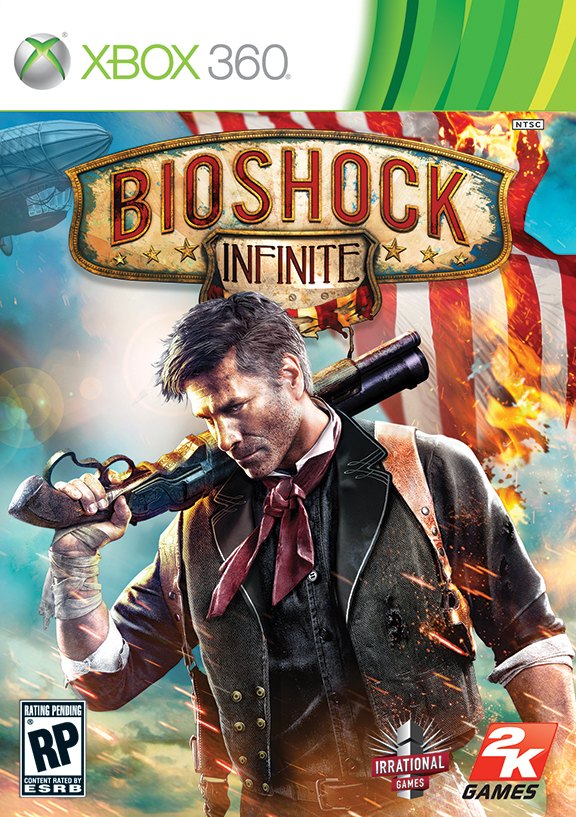
The History of BioShock Infinite
BioShock Infinite (March 26, 2013) leaves the sea for Columbia, a floating city of 1912, and a rescue that becomes an argument about America itself. It scored 94 on Metacritic on PC and PlayStation 3, was the third-highest rated game of 2013, and has sold more than 11 million copies.
THE MAKING
Irrational Games, five yearsIrrational and Ken Levine first declined to return to BioShock at all; the sequel went to 2K Marin while Irrational worked elsewhere. By contract renewal in mid-2008 Levine wanted the series back, and the main team began the game that would ship five years later as Infinite, under the working name Project Icarus. The record of the production is unusually frank: hundreds of staff, wasted work, missed deadlines, and outside help brought in to make sure the game shipped at all.
The setting came from history Levine has discussed on record: the 1893 World's Columbian Exposition in Chicago and the idea of American exceptionalism, with more recent events, the Occupy movement among them, feeding the class war between Columbia's Founders and the Vox Populi. The design center was Elizabeth, built to be a companion rather than an escort charge; Levine brought her voice actor, Courtnee Draper, and Booker's, Troy Baker, into the development process itself to shape the pair's interplay.
THE GAME
Columbia, Tears, and the Sky-LineBooker DeWitt, a disgraced Pinkerton agent drowning in gambling debts, is sent to Columbia in 1912 to retrieve Elizabeth, a young woman locked in a tower since childhood, guarded by the mechanical Songbird. Elizabeth can open Tears, rifts into alternate realities, which is also the game's explanation for its most famous anachronism: the 1980s pop songs playing in 1912, heard through Tears and rearranged for period instruments. That story has its own page in this Library. Combat opens up with the city: the Sky-Line rails let Booker fight at speed across Columbia's floating districts, with Elizabeth tossing him supplies and opening Tears in battle rather than waiting to be protected.
BURIAL AT SEA
The return to Rapture, 2013 to 2014Infinite's story expansion, Burial at Sea, takes Booker and Elizabeth back to Rapture on the eve of its fall, and ties Infinite's ending directly into the first game's story. Episode One (November 12, 2013) drew mixed reviews, praised for the return and faulted for its short length. Episode Two (March 25, 2014), played as Elizabeth, was received far more warmly, with multiple critics calling the pair a fitting swan song for Irrational's work on BioShock as the studio reorganized around Levine.
THE EDITIONS
One date for the West, weeks for JapanTHE RECEPTION
Acclaim, with the dissent keptTHE LEGACY
The best-selling BioShock, and the lastInfinite is the series' commercial peak, 3.7 million copies in two months on the way past 11 million, and its critical peak alongside the original. It is also, so far, its end: Irrational reorganized after Burial at Sea, Levine moving to a smaller team, and no fourth BioShock has shipped since. The trilogy survives as the Collection, and Infinite's reputation survives with it, argued about in the same terms as on launch day, which is its own kind of permanence.
THE GAME ON THE SHELF
BioShock Infinite · 2013