
The History of Bomberman
The first Bomberman was a Japanese home computer game of July 1983, written in BASIC and called Bakudan Otoko, Bomb Man: a man in a bowler hat wiping out balloon shaped ghosts in a maze, one cross shaped explosion at a time. In Britain the same game, scrubbed of its title, was sold as Eric and the Floaters. Nobody involved could have guessed the maze would still be selling forty years later.
The famous version is the Famicom rebuild of December 20, 1985, programmed by Hudson director Shinichi Nakamoto. Nakamoto kept the formula, added the power up system that lets Bomberman grow stronger panel by panel, and made the decision that fixed the character forever: the bowler hatted man became a robot, borrowed outright from the enemy sprites of Hudson's own Famicom port of Lode Runner. His reasoning, on the record, was practical and a little cold. If the hero were a robot, he would not feel too sorry watching him blown apart by his own bombs. The game's ending completes the joke: clear the fiftieth stage and Bomberman turns human, into the hero of Lode Runner itself. The first Bomberman is, by its own ending, a Lode Runner prequel.
THE TWO COVERS
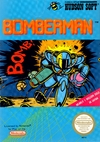
Same maze, two sales pitches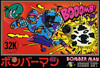
HOW IT WAS MADE
A marathon, a sample, and a techno scoreTHE REINVENTION
Multiplayer made the seriesRead the reviews of the 1985 game and a pattern forms: fun, simple, and missing something. That something was other people. The original has no multiplayer at all, and retrospective reviews of every reissue say so. Hudson fixed it on the PC Engine. Bomberman (1990) for the TurboGrafx-16 rebuilt the formula around battle play for up to five players, and Super Bomberman (1993) carried it to the Super NES bundled with Hudson's own Super Multitap, the adapter that put four controllers on one port. Super Bomberman 3 raised battle mode to five players. From there the series' center of gravity never moved back: the maze is a party game that happens to have a solo mode attached.
The volume followed. The franchise passed 70 games and, by the commonly cited 2007 count, over 10 million copies. At the late 1990s peak Hudson averaged about six Bomberman releases a year. When Hudson was dissolved in 2012 the series passed to Konami intact, and Super Bomberman R opened the Nintendo Switch era in 2017 as a launch title, proof that the formula Nakamoto rebuilt in three days had outlived the company that made it.