
The History of Breath of Fire II
Breath of Fire II (Super Nintendo, 1994) is a direct sequel, the rarity in this series: five centuries after the first game, another Ryu, an orphan whose family vanished and whose village forgot him, uncovers the Church of St. Eva, a faith that harvests the prayers of its worshippers for a demon god. It is bigger and stranger than its predecessor, and its English translation is one of the most famously rough of the 16-bit era. Both facts are part of its history.
THE BOX
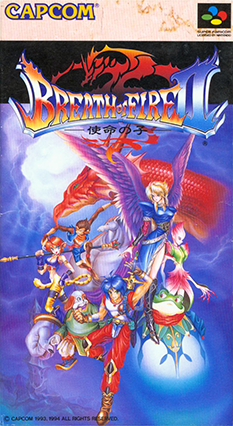
The Japanese subtitle, Shimei no Ko (the Destined Child), names what the story calls Ryu. The American box, not staged here, remains a documented gap. The Japanese file staged is 233px wide, below the Library's working standard, and is a swap-in upgrade when a larger scan is verified.
THE MAKING
The same team, one artist promotedProducer Tokuro Fujiwara and designer Yoshinori Kawano returned, with Makoto Ikehara writing. The cast was designed entirely by Tatsuya Yoshikawa, who on the first game had inherited Keiji Inafune's designs midway; here the whole party, nine playable characters, is his from the start. The score was written by a single newcomer, Yuko Takehara, where the first game had used four composers; J-pop singer Mio Watanabe recorded the Japanese television commercial theme, Owaranai Ai (Unending Love), released as a single in December 1994.
The release circumstances were harder than the first game's. Breath of Fire II launched in Japan on December 2, 1994, the same week as Sony's PlayStation, and still debuted seventh on the Japanese charts with 89,700 copies, reaching 350,000 in Japan by the end of 1995. And the American handling changed: where Square Soft had carried the first game, Capcom USA localized and published this one itself, a year after Japan. Europe followed in April 1996 through Laguna, the series' first European release on SNES.
THE DESIGN
Build a town, fuse a partyTwo systems define it. TownShip: a hideout the player rebuilds into a village, choosing one of three carpenters, each with a building style, and inviting characters found across the world to live and work there. And the Shamans: six elemental holy women who can be fused, two at a time, into party members, changing their forms and granting new abilities, an early fusion system with visible transformations.
Around those sit a Monster Meter showing encounter probability, a Formation system trading speed, defense, and attack by positioning, and a story willing to run long: demons wearing human offices, a false church, a sister who is not what she seems, and two real endings, one of which asks Ryu to make his mother's sacrifice permanent.
THE EDITIONS
SNES, then a faithful GBA portTHE RECEPTION
Loved and faulted, often in the same reviewThe dissent is unusually blunt. Next Generation called it larger and more involved than its predecessor but much less interesting, with too little direction, a purely mechanical storyline, and the clunkiest dialogue since Night Trap. GameSpot's Virtual Console review called the localization terrible and the effort hasty and careless, while Eurogamer, noting the high random battle rate, still called it a beautifully crafted and impeccably produced adventure. Later lists split the difference: Nintendo Power ranked it 171st of its top 200 Nintendo games, ten places behind the original; IGN placed it 53rd in its Top 100 SNES Games.
THE LEGACY
The ambitious oneWithin the series, Breath of Fire II is the maximalist entry: the direct sequel, the town builder, the fusion system, the dark church plot. Its systems, inviting named NPCs to populate a home base, fusing characters into new forms, were later RPG staples built here in 1994. Its translation became the cautionary tale instead, quoted for decades as what a rushed one-year-later localization does to a script, and every re-release since has been reviewed partly as an occasion to regret that it was never redone.