
The History of Breath of Fire
Breath of Fire (Super Nintendo, 1993) was Capcom's first traditional role-playing game. A boy named Ryu, one of the last of the Light Dragon Clan, crosses a world of animal clans to rescue his sister and stop the Dark Dragons from waking a mad goddess. Capcom, unsure of the genre in America, handed the English release to Square Soft, which localized and promoted it. The experiment founded a series.
THE BOX
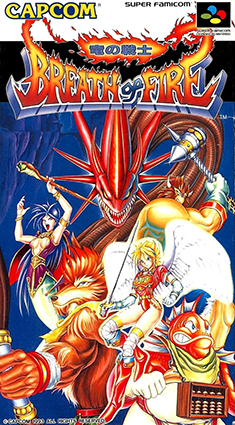
The Japanese title carries a subtitle the American box dropped: Breath of Fire: Ryu no Senshi. The American box, not staged here, remains a documented gap. The Japanese file staged is 235px wide, below the Library's working standard, and is a swap-in upgrade when a larger scan is verified.
THE MAKING
Ghosts 'n Goblins people, a new genreThe game was designed by Yoshinori Kawano and produced by Tokuro Fujiwara, creator of Ghosts 'n Goblins, neither a background in role-playing games. Keiji Inafune designed the characters, but his supervisor removed him from the project and replaced him with Tatsuya Yoshikawa, who kept many of Inafune's design features in the finished illustrations. Cameos from other Capcom franchises, Chun-Li among them, were tucked into the game as Easter eggs.
The music came from four members of Capcom's in-house sound team Alph Lyla: Yasuaki Fujita, Mari Yamaguchi, Minae Fuji, and Yoko Shimomura, credited under pseudonyms, with further uncredited work by Tatsuya Nishimura. No soundtrack album appeared at the time; the music waited for the series' Original Soundtrack Special Box in 2006.
THE DESIGN
Eight party members, one dragonRyu recruits seven companions, each from a different clan and each with personal actions outside battle that open the world: Nina of the winged Windia clan; Bo the wolf-man archer; Karn the thief, who can fuse party members into single powerful fighters; Gobi the fish-man merchant; Ox the blacksmith; Mogu the mole who digs; and Bleu, an immortal serpent sorceress. Four fight at once, and reserves can be swapped in mid-battle.
Ryu's own arc is mechanical as well as narrative: his sealed dragon powers awaken through trials, and transformation becomes the series' signature. The enemy health bar is a color strip rather than a number, and stronger bosses can fight on after it empties, their true remaining health hidden, an early lesson in this game's quiet cruelties.
THE EDITIONS
Square Soft presents a Capcom gameTHE RECEPTION
Praise, with the dissent keptThe dissent: GamePro found the story nondescript and average and the whole experience bland, wishing Capcom had tried for more interesting enemies or stronger graphics; Nintendo Power praised the exploration and relative non-linearity but called the plot standard and the fighting heavier than adventure fans might like. Commercially, the game was a considerable success in Japan and only modest in North America at first; Nintendo Power later noted a rare second wind in US sales after the sequel arrived in December 1995.
THE LEGACY
A series, and a localization lineageBreath of Fire became a Capcom staple, running to six main entries, and its habits, a Ryu and a Nina in every era, dragon transformation as the hero's burden, animal clans as the world's peoples, were set here. Its American release is also a document of how the 16-bit RPG market actually worked: one company's game, another company's localization and marketing muscle, and a translator, Woolsey, whose compressed, abbreviated English defined a generation's memory of these games. Two licensed manga followed in Japan, one retelling the game and one continuing Ryu and Nina's story.