
The History of Breath of Fire V: Dragon Quarter
Breath of Fire: Dragon Quarter (PlayStation 2, 2002) is the fifth entry and the great rupture. In Japan it kept the numeral, Breath of Fire V: Dragon Quarter; the West dropped it. Humanity has fled a ruined surface for bunkers a kilometre down, where your D-Ratio, your measured worth as a citizen, decides how high you may live. Ryu is a ranger with a D-Ratio of 1/8192, nearly the lowest number there is, assigned to escort Nina, a girl surgically rebuilt to filter the poisoned air, toward a sky neither of them has seen.
THE MAKING
Production Studio 3 reads Ryū MurakamiThe project was headed by series veteran Makoto Ikehara, directing his third consecutive entry, with Hironobu Takeshita producing, Tatsuya Yoshikawa designing, Yukio Andoh writing, and, for the first time, an outside composer: Hitoshi Sakimoto, with Yasunori Mitsuda as sound producer. Development began in April 2000, the month the fourth game shipped, with a team of around forty, half of them on graphics.
Ikehara took the setting from Ryū Murakami's 1994 alternate-history novel Gofungo no Sekai (The World Five Minutes From Now) and a deliberate dissatisfaction: he felt the earlier games were too easy beside rival RPGs, and the difficulty rose as development went on. The finished game was dedicated to the memory of Capcom employee Yasuhito Okada. An online mode and a fishing minigame, the series' oldest pastime, were cut along the way.
THE DESIGN
Restarts as a system, power as a countdownThree machines replace the old structure. The Scenario Overlay System expects failure and prices it: give up or die, and you may restart from your last save or from the beginning, carrying equipment, skills, and a pool of Party Experience, while your rising D-Ratio opens scenes and areas that a first run cannot reach. The D-Counter appears when Ryu's dragon power wakes: a percentage that rises with every step and every dragon ability, can never be lowered except by restarting, and ends the game outright at 100 percent.
Battles, the Positive Encounter Tactics System, are fought on the field with traps, bait, pre-emptive strikes, and Action Points spent on both movement and attacks, strung into combinations. Permanent saves cost scarce save tokens; the suspend save deletes itself when loaded. Ryu has exactly one dragon form, against the series' traditional menus of them, and a single run lasts around ten hours, because the game is the sum of its runs.
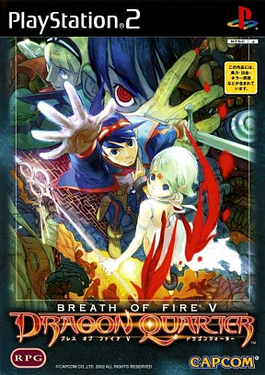
THE BOX
THE EDITIONS
Three regions, three rulebooksTHE RECEPTION
Praised, argued over, and undersoldGamePro's summary stands for the whole reception: a sequel "that couldn't be more different if it tried," with astonishing combat and a restart structure its reviewer counted as the biggest downfall. The argument was never about whether the game was made with care. It was about whether the care had been spent in the right direction.
THE LEGACY
The last console Breath of FireDragon Quarter closed the console series. In 2004 IGN placed it sixth on a list of the PlayStation 2's hidden gems, noting the strangeness of a flagship 32-bit-era RPG franchise selling under 135,000 copies in North America. Its design, failure carried forward as progress, has only become easier to read since. The Library's companion page takes the reinvention apart system by system.