From the Library: covers, censuses, and editions, documented. Browse the Library →
SOJ Bushido Blade ยท Vintage Fighting Games
← Back to the Fighting Games Gallery

The History of Bushido Blade

The fighting game that threw away the health bar and trusted a single sword stroke to decide everything.

Bushido Blade is a one on one weapon fighting game for the PlayStation, developed by Lightweight and published by Square in Japan and Sony Computer Entertainment in the West. It was released in Japan on March 14, 1997, in North America on October 16, 1997, and in Europe on February 1, 1998.

It arrived in a genre built on health bars, timers, and twenty hit combos, and refused all three. There is no time limit and no health gauge. Most clean hits kill outright, and the hits that do not kill wound specific body parts instead. That single decision made it one of the most discussed fighting games of the PlayStation era.

HOW IT WAS MADE

A first game, built as a simulator
LIGHTWEIGHT'S FIRST TITLE
Bushido Blade was the first game developed by Lightweight, at the time a partially owned subsidiary of its publisher, Square. The project was directed by Kunihiko Nakata.
A SWORDSMANSHIP SIMULATOR
Nakata said he wanted to add tension to the fighting game formula by making a one hit kill possible. Hit detection was implemented separately for the torso, the head, and the limbs, to make the game more of a swordsmanship simulator than a fighting game.
SIX FIGHTERS, EIGHT WEAPONS
Six playable characters choose from eight weapons: katana, nodachi, long sword, saber, broadsword, naginata, rapier, and sledgehammer. Each weapon has a realistic weight and length, and fixed values for power, speed, and blocking.
THREE STANCES, ONE CONNECTED CASTLE
Attacks change across high, neutral, and low stances, chained by the Motion Shift System. Fights are not fenced into small arenas: the castle compound is one large, connected hub of groves, moats, and bridges that fighters can run, jump, and climb through, even mid fight.
MODERN DAY, OLD CODE
Despite the samurai cinema surface, the story is set in the modern era, complete with a helicopter landing pad. A 500 year old dojo, the Meikyokan, houses an assassin society called Kage, torn apart after its leader Hanzaki finds a cursed sword, the Yugiri.
THE MUSIC
The score was composed by Shinji Hosoe with Ayako Saso and Takayuki Aihara, built around flute, violin, and the shamisen. Its 23 tracks were later released on CD in 2001, paired with Square's Driving Emotion Type-S.

Nakata also explained the game's idea of bushido: not the Edo period Hagakure ideal of the way of dying, but an older teaching that emphasized the warrior's own survival. That distinction runs through the whole design. This is a game about not being hit, not about dying beautifully.

THE RELEASE

Delayed once, then sold in convenience stores
MARCH 14, 1997 IN JAPAN
Originally slated for February 1997, the Japanese release slipped to March to make room for the debut of Square's Aques line of sports games. Square presold it in Japanese convenience stores, the same treatment it had given Final Fantasy VII at Lawson.
BLOOD FOR AMERICA
The North American release added blood, replacing the yellow flash that marked a fatal blow in Japan. The ESRB still rated it Teen, while Europe's ELSPA gave its release a stricter 18+ rating.
387,937 COPIES IN JAPAN
Bushido Blade was the 25th best selling game of 1997 in Japan, selling nearly 388,000 copies. In the United States it sold 324,083 units as of January 2003, for a documented total of 712,020 across the two markets.

THE TWO COVERS

Same game, two shelves
US box art
United States
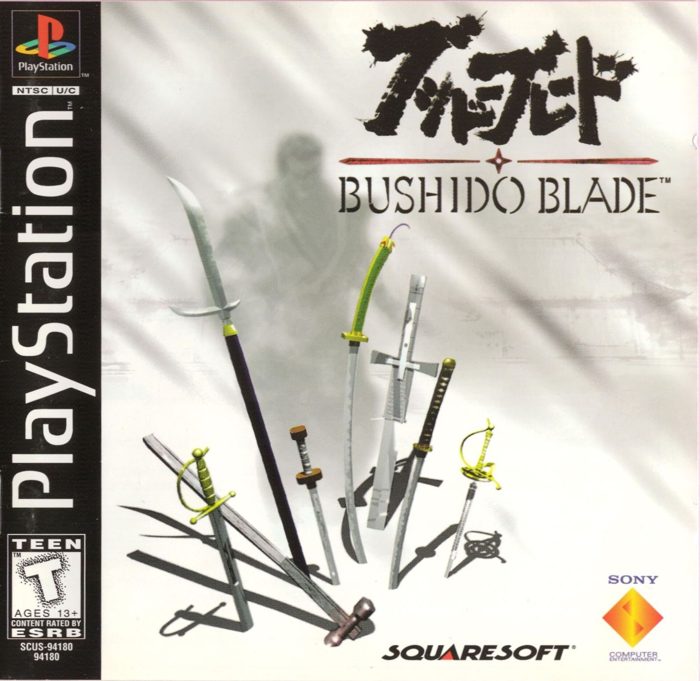
The same ring of planted weapons, reframed for America: a black PlayStation spine, an ESRB Teen box, and the title spelled out in full under the brush logo.
Japanese box art
Japan
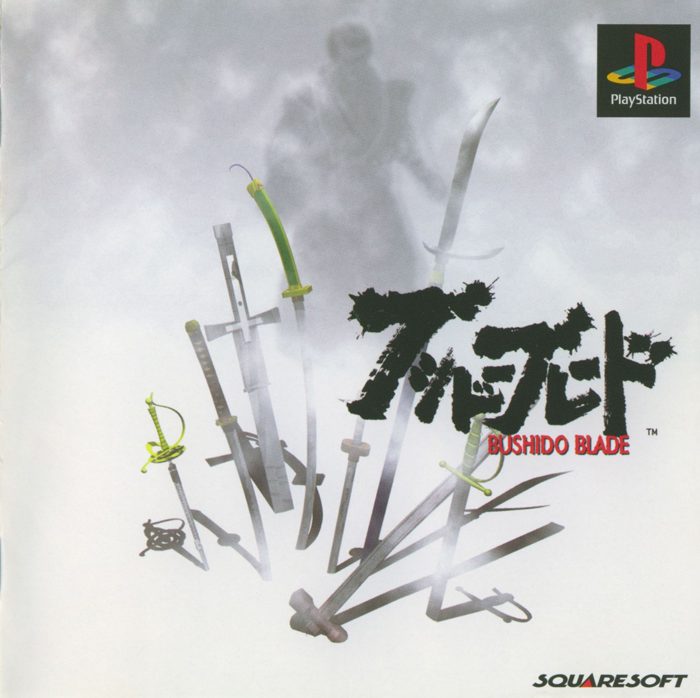
The Japanese original is quieter: the weapons stand in mist under the brush logo, with only a small red BUSHIDO BLADE under the calligraphy and the Squaresoft name at the foot.

HOW IT WAS RECEIVED

Loved, hated, and scored both ways
GAMESPOT, 8.9 OF 10
GameSpot called the one hit kills the game's most exciting and preposterous feature, destined to earn it just as many fans as detractors, and summed the game up as a bold undertaking, but a remarkably successful one.
IGN, 8.7 OF 10
IGN called the fighting system extremely innovative, yet still not so ambitious as to have lost the point, and closed its review: I can't recommend Bushido Blade enough. Simply amazing.
NEXT GENERATION, 5 OF 5
Next Generation gave it a perfect score, writing that it does not offer arcade style button mashing or twenty hit combos, but does offer the closest you can get to the real thing without actually getting cut.
FAMITSU, 31 OF 40
In Japan, Famitsu scored it 31 of 40, and its readers later voted it number 85 in the magazine's top 100 PlayStation games of all time in November 2000.
EGM, 7.375 OF 10, AND SPLIT
Three of Electronic Gaming Monthly's four reviewers scored it 7 or lower, arguing the novelty wears off and one hit kills can feel arbitrary. The fourth, Crispin Boyer, gave it a 9, praising a game where survival depends on concentration and reading an opponent's posture, not on memorized button strings.
THE DISSENT
GamePro called the realism a love or hate proposition, noting that learning restraint and discipline would not go over well with the Tekken and Street Fighter generation. Computer and Video Games scored it just 2.5 of 5, and Edge gave it 6 of 10. Reviewers praised the graphics, the continuous arenas, and the limb disabling, and complained that trees could block the camera's view.

WHAT IT LEFT BEHIND

A sequel, a successor, and a long afterlife

Bushido Blade 2 followed on PlayStation in 1998, released in Japan on March 12 and in North America on October 29. It rebuilt the story around two rival schools, the Narukagami and the Shainto, replaced the one connected castle with a series of separate skirmishes, and added dual sword fighting. Contemporary reviewers at GameRevolution noted what it quietly dropped: leg injuries no longer cripple, fights stay on a single battlefield, and the Bushido code of the first game is gone entirely.

Lightweight carried the idea forward itself with Kengo: Master of Bushido for the PlayStation 2, widely treated as Bushido Blade's spiritual successor. Square kept the original in print with a Legendary Hits reissue in Japan, and added it to the Japanese PSone Classics line in 2008.

The honors kept accumulating quietly. Bushido Blade was nominated for Console Fighting Game of the Year at the inaugural Interactive Achievement Awards in 1999, ranked number 190 on 1UP's list of the greatest 200 video games of their time in 2006, and made GamesRadar's 2010 list of seven 1990s games that need HD remakes. No remake has come. What remains is the cleanest statement the genre ever made: a sword fight should be decided the way a sword fight is decided.

More fighting games →

THE FIRST WORD

First word on new listings, plus a subscriber promo code for the eBay store.