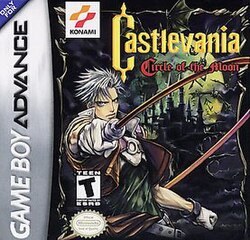
The History of Castlevania: Circle of the Moon
In 1830, at an old castle in Austria, the vampire Camilla resurrects Dracula, and the hunter Morris Baldwin arrives with his two apprentices, his son Hugh and Nathan Graves, the orphan Morris chose to inherit the Hunter Whip. Dracula drops the two young men into the catacombs, and Nathan climbs the castle alone. Castlevania: Circle of the Moon (Game Boy Advance, March 2001), Akumajo Dracula: Circle of the Moon in Japan and simply Castlevania in Europe, was a launch title for the system and the first portable Symphony.
THE MAKING
Konami Kobe builds a standalone castleThe game was developed by Konami Computer Entertainment Kobe, directed and designed by Koji Horie, and built deliberately as a stand alone title, announced at Space World 2000 and shown at the Tokyo Game Show that autumn. Series producer Koji Igarashi was not involved, a fact that shapes the game's whole afterlife.
Its signature system is the Dual Set-Up System: twenty cards, ten Action and ten Attribute, dropped at random by enemies, paired to make 100 combinations of magic effects, from elemental whips to stat changes. Four further modes, Magician, Fighter, Shooter, and Thief, unlock by code after each completion, remixing Nathan's statistics for another climb.
THE EDITIONS
One game, a shelf of versionsTHE RECEPTION
Acclaim, with the dissent keptThe standing complaint was visibility: the graphics were dark, and on the original non backlit Game Boy Advance screen the castle was genuinely hard to see, a flaw reviewers split between the game and the hardware. Konami reported over 500,000 copies sold by July 2001, over 300,000 of them in North America. IGN called it one of the best playing Castlevania games released, long and extremely challenging without becoming a chore.
THE LEGACY
Removed from the timeline, restored to the shelfIn 2002, Igarashi removed Circle of the Moon from the series' official timeline. His stated reason was the development team's own intention that it stand alone, not his absence from it, though he also criticized its controls, its dark graphics, and a card system he felt did not match the world Castlevania had built. Fans resisted the removal, and the game kept its standing anyway: it was the proof, at a new system's launch, that the Symphony model worked on a handheld, and its Advance Collection return in 2021 put it back on the shelf beside the games that followed it.
THE GAME ON THE SHELF
Circle of the Moon · GBA