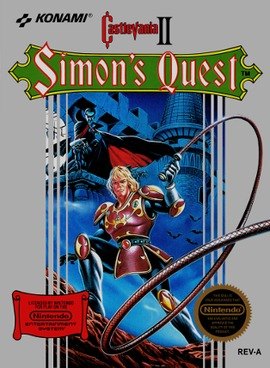
The History of Castlevania II: Simon's Quest
Seven years after the first game, Simon Belmont is dying of Dracula's curse. The cure is perverse: gather the five scattered parts of Dracula's body, carry them to the castle ruins, resurrect him, and kill him properly. Castlevania II: Simon's Quest (Famicom Disk System, August 28, 1987; NES, 1988) abandoned the straight corridor for an open world of towns, merchants, and liars, and sold over one million copies doing it.
THE MAKING
Konami, 1987Hitoshi Akamatsu designed and directed again. The Western title itself is his: the game is Dracula II in Japan, and Akamatsu created the name Simon's Quest for the Western release. Asked whether Nintendo's Metroid had influenced the game's turn toward exploration, Akamatsu instead cited Konami's own The Maze of Galious (1987), a platform adventure with puzzle solving and a world map. That answer is Tier 1, the director on record, and it is the correct root for the family tree that later grew the word Metroidvania.
One loss shadows the whole early series: most of the original artwork for Simon's Quest and the other early Castlevania games was lost in the Great Hanshin earthquake of 1995, which is part of why the Famicom era's art survives mainly on its boxes.
THE DESIGN
Towns, nightfall, and unreliable witnessesSimon's Quest introduced the series' open structure: a world map the player can explore and revisit, villagers who offer clues, merchants who take hearts as currency, purchasable whips, and an experience system that raises Simon's power and health. Above it all runs the day and night cycle: by day the countryside is survivable; at night enemies strengthen, and the villagers vanish from their towns, replaced by zombies.
The villagers are the game's most famous mechanic and its most famous problem. Producer Koji Igarashi later revealed that the Japanese villagers were deliberate liars by design; the English translation then lost the subtlety of the honest hints among them, producing immortal lines like the instruction to hit Deborah Cliff with your head. Kenichi Matsubara's score gave the series one of its permanent themes: "Bloody Tears" debuted here and has recurred ever since.
THE EDITIONS
One game, a shelf of versionsTHE RECEPTION
Acclaim, with the dissent keptThe retrospective dissent is the loud one, and it is kept here in full: backtracking, easy bosses, cryptic puzzles with, in places, no clues at all, such as kneeling at Deborah Cliff with the Red Crystal to summon a tornado. 1UP concluded the game required a walkthrough. Game Informer's summary is the fairest sentence available: an important game in history, and a polarizing one. Both halves of that sentence are why this page exists.
THE LEGACY
The road to Symphony of the NightThe direct line is documented by the man who drew it. Koji Igarashi, assistant director of Symphony of the Night, said the critical reaction to Simon's Quest, a Castlevania more focused on exploration than action, is what allowed him to pitch Symphony to Konami. The body-part hunt also recurs inside the fiction: in Harmony of Dissonance, Juste Belmont recounts his grandfather Simon's search and repeats it.
And the game owns one of magazine history's famous covers. Nintendo Power put Simon's Quest on the cover of its second issue in 1988, a costumed Simon holding Dracula's severed head; parents telephoned complaints that it gave their children nightmares, and the magazine later named it its worst cover. The Library's guides page tells that story beside the guide census.
THE GAME ON THE SHELF
Simon's Quest · NES