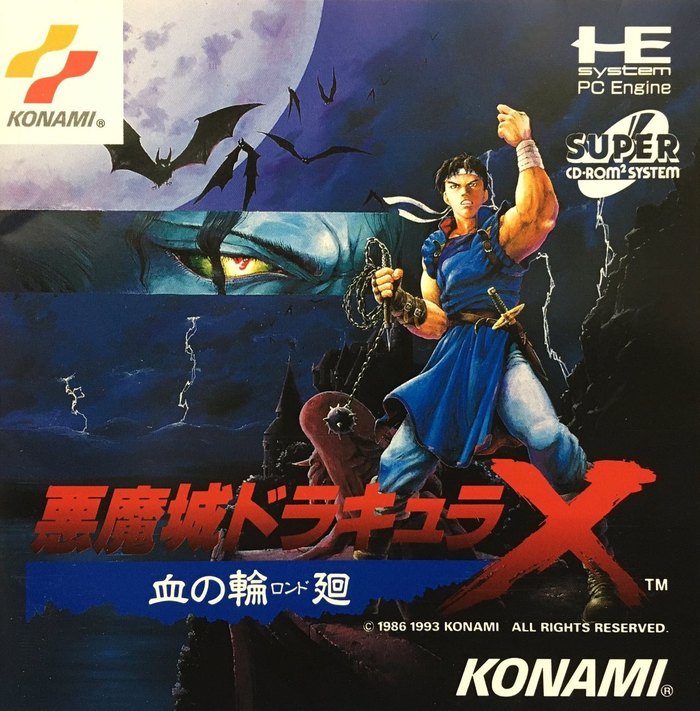
The History of Castlevania: Rondo of Blood
In 1792 the priest Shaft resurrects Dracula, and 19 year old Richter Belmont, heir to the Vampire Killer whip, fights through the castle to rescue his beloved Annette and the maidens taken with her. Castlevania: Rondo of Blood, in Japan Akumajo Dracula X: Chi no Rondo (PC Engine Super CD-ROM2, October 29, 1993), is the tenth Castlevania game, the direct prequel to Symphony of the Night, and for fourteen years the series' most famous absence: it was released only in Japan.
THE MAKING
A CD game at the end of the classic eraToru Hagihara directed, with Yoshiaki Yamada producing. The X in the Japanese title marks the tenth installment, and the hardware marks the ambition: the series' first CD game, built for the PC Engine Super CD-ROM2, with Red Book audio, voiced animated cutscenes, and room for a castle far larger than a cartridge of the day allowed.
The design sits exactly between two eras. The stages are linear and untimed like the early games, but they branch: four alternate routes, alternate endings to some levels, and four rescuable maidens hidden along the way. One of them, 12 year old Maria Renard, becomes a second playable character, faster and more fragile than Richter, attacking with doves and animal companions. The game also introduced the Item Crash, the super attack that spends hearts to unleash a sub weapon at full power, which later games kept.
Richter's six sub weapons, axe, dagger, bible, pocket watch, cross, and holy water, and the score's mix of CD audio and the onboard sound chip set a production standard the series carried forward. Songs from Rondo later turned up as a pre-order bonus for Portrait of Ruin, and its monsters were reused wholesale by its sequel.
THE JAPAN DOOR
What the West got insteadThe original never left Japan on its own hardware. The PC Engine's Western counterpart, the TurboGrafx-CD, was a niche machine in America, and Konami never released Rondo for it. What the West received, in 1995, was Castlevania: Dracula X for the Super NES, known in Japan as Akumajo Dracula XX and in Europe as Vampire's Kiss: a different game built from Rondo's plot, characters, and some of its graphics, with all new levels and altered play, shaped by the limits of a cartridge and by the original's platform exclusivity.
That substitution shaped Rondo's legend. Western magazines praised a game their readers could not buy: Electronic Gaming Monthly called it potentially the best CD title yet, argued its only flaw was not being released in the United States, and named it Best Japanese Action Game of 1994. Import copies became the series' holy grail, and the game stayed a rumor with a soundtrack for over a decade.
THE EDITIONS
One game, a shelf of versionsTHE RECEPTION
Acclaim, with the dissent keptThe honest commercial footnote: in Japan the game sold 14,436 copies in its first week and 19,616 in its first month, modest numbers for a machine in decline. Its reputation was built later, by imports, by Symphony of the Night's success, and by the long wait itself.
THE LEGACY
The door finally openedRondo is the hinge of the whole series. It closes the classic era at its peak, hands Richter, Maria, and Shaft directly to Symphony of the Night, which opens with its final battle, and supplies the Item Crash and branching stage grammar the later games inherited. When the original finally reached the West, first as an unlockable in 2007 and then on Virtual Console and in Requiem, it arrived as canon rather than curiosity.
Its afterlife keeps growing: Richter and Maria lead the Netflix series Castlevania: Nocturne (2023 to 2025), set in the same 1792 of this game, and the original is playable on the TurboGrafx-16 Mini. The Japan door is open now. This page exists because for fourteen years it was not.
THE GAME ON THE SHELF
Rondo of Blood · PC Engine CD