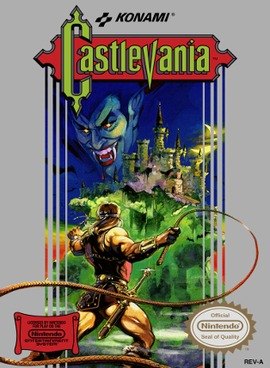
The History of Castlevania
In the year 1691, Dracula returns, a century after Simon Belmont's ancestor destroyed him, and Simon takes the family whip into the castle to finish the job again. Castlevania, Akumajo Dracula in Japan, launched on the Famicom Disk System on September 26, 1986, reached the American NES in 1987, and sold over one million copies. It is the first stone of everything this shelf holds.
THE MAKING
Konami, 1986Hitoshi Akamatsu directed, with Akihiko Nagata producing and designing and Kinuyo Yamashita and Satoe Terashima composing. Akamatsu, a film admirer who worked with what he called a film director's eye, said the visuals and music were "made by people who consciously wanted to do something cinematic": he wanted players to feel they were inside a classic horror film. That is a Tier 1 statement, from the director himself, and it explains the game's strangest flourish, an end credits sequence that bills the monsters to joke names honoring Hammer horror stars, documented on this Library's credits page.
The hero was nearly a different man. Simon was originally named Peter Dante, a compound of Peter Cushing and Joe Dante, and made the grandson of a Christopher Dante, for Christopher Lee. Planned features that did not survive included a whip that could strike in multiple directions, an idea the series finally used in Super Castlevania IV, and sub-weapons such as garlic, wooden stakes, and an item that turned the player into a werewolf.
The game was developed in tandem with Konami's MSX2 title Vampire Killer, released a month later with the same premise, characters, and setting but different, more exploratory mechanics. In Europe, Vampire Killer was the series' first release of all.
THE DESIGN
Eighteen stages, six bosses, one whipThe structure is a film in six reels: six blocks of three stages, eighteen stages, each block ending in a boss drawn from classic horror, Frankenstein's monster and the Grim Reaper among them, and Dracula himself at the top of the last staircase. The whip even has a wind-up: a short delay sits between the button press and the crack, a timing every player learns in their hands.
Around the whip sits the economy that defined the series: candles hold hearts, hearts power the sub-weapons, the knife, the axe, the holy water, the time-stopping watch, and the boomerang cross, and only one sub-weapon can be carried at a time. The American name, meanwhile, was one executive's discomfort: Konami of America senior vice president Emil Heidkamp objected to the religious weight of Akumajo Dracula, which he believed translated as "Dracula Satanic Castle." The Library's name page tells that story in full.
THE EDITIONS
One game, a shelf of versionsTHE RECEPTION
Acclaim, with the dissent keptThe dissent, such as it was, aimed at the packaging rather than the game. Beep felt Konami may have focused too much on graphics and found the game relatively short; CVG called the graphics "gaudy" in the same review that concluded "it's the gameplay that counts, and it's great." The retrospective verdict removed the qualifications: Nintendo Power ranked it the 22nd best game on a Nintendo system in 2006 and the 14th best NES game in 2008, Game Informer placed it 48th among the best games ever made in 2001, and IGN ranked it 19th among NES games, praising its difficulty, soundtrack, and visuals.
THE LEGACY
The second wave of the NESCastlevania is counted among the first major platform games on the NES and part of the system's unofficial second wave, the moment the library grew up. Its influence is documented in at least one direct line: Tecmo's Ninja Gaiden (1988) borrowed its power-up item grammar from this game. Retro Gamer has called it one of the most enduring video games ever made, attributing that less to unique mechanics than to its adult atmosphere and challenge.
Everything on this shelf descends from these eighteen stages: the whip, the hearts, the castle that returns on a hundred-year cycle, and a director's idea that a game could be staged like the horror films he loved.
THE GAME ON THE SHELF
Castlevania · 1986