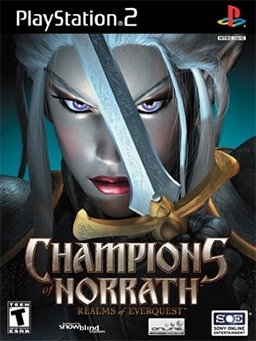
The History of Champions of Norrath
Champions of Norrath: Realms of EverQuest (PlayStation 2, 2004) took the world of Sony Online Entertainment's EverQuest, then the biggest name in online role-playing, and rebuilt it as something EverQuest itself was not: a dungeon crawler you could finish on a couch, alone or with three friends, no subscription required. This history is deliberately shorter than the others on this shelf. The game's documented development record is genuinely thin, and this Library does not pad a thin record. What is documented is solid, and it is all here.
THE MAKING
Snowblind, hired off Dark AllianceChampions of Norrath was developed by Snowblind Studios, the studio behind Baldur's Gate: Dark Alliance, and it runs on a reworked and expanded version of that game's engine. It was published by Sony Online Entertainment in North America and by Ubisoft in Europe, designed by Paul Knutzen and Chris Avellone, with music by Inon Zur. Retrospective coverage of the studio split of the era records why Snowblind got the call: Sony Online Entertainment hired the studio fresh off Dark Alliance to give its flagship world a console offering, while Dark Alliance 2 went to a different team.
Beyond that, the contemporary development record available to this build is mostly the game itself speaking: an EverQuest setting placed before the events of the first EverQuest and before the Shattering of the moon Luclin, five acts running from the elves' war against an orc and goblin alliance down into the underworld, and three antagonists, the orc leader Pelys, the vampire Vanarhost, who also narrates, and Innoruuk, the God of Hatred.
THE DESIGN
Five classes, random loot, and a character who travelsPlayers build their own champion rather than inherit one: five classes drawn from EverQuest's races, Barbarian Warriors, Wood Elf Rangers, High Elf Clerics, Erudite Wizards, and Dark Elf Shadowknights, each in male and female versions that differ in appearance only, and fixed once created. Skills grow along an Ability Tree, with points that can be spread across several branches at once and can never be taken back once spent.
The loot loop is the engine's signature: equipment drops from enemies, often better than anything in the shops, every item carries weight against a strength based carrying limit, Gate Scrolls warp the party back to sell, and rare components can be fused into weapons and armor to add statistical bonuses, elemental attack, and attack speed. Dungeons mix bosses, traps, and destructible walls hiding secret passages, with two advanced bonus dungeons waiting after the credits. Characters can be imported and exported at will, keeping their statistics and items, a feature built for moving between solo, multiplayer, online games, and the sequel.
THE MULTIPLAYER
Four players, on a couch or on a network adapterThe game's claim on its era is the co-op. Up to four players can adventure together, locally with a Multitap or online through the PlayStation 2 Network Adapter, joining parties and quests from a save point and bringing their own imported characters with them. Player damage against fellow players was disabled online; it was a cooperative game in structure, not just in marketing. In 2004 that combination, four player online co-op in a console action RPG, was close to unparalleled, as retrospective coverage of the game has since put it.
The online half ended on April 2, 2013, when the servers shut down. The couch half never required them.
THE EDITIONS
Two regions, one sequel, no Japanese releaseTHE RECEPTION
An 85, and a perfect score from GameProTHE LEGACY
The engine's second careerChampions of Norrath gave the Dark Alliance engine a second life in a second famous world, proved a subscription MMO's setting could carry a single purchase console game, and set the four player co-op bar its sequel and its genre peers were measured against on the PlayStation 2. Snowblind's engine went on to power further action RPGs of the era, and the studio itself was later absorbed into Monolith Productions.
For this Library, the game's interest is also its shape on the shelf: a major 2004 action RPG with no Japanese edition at all, the mirror image of the Japan first stories around it, and a reminder that the PS2 RPG bench ran in both directions across the Pacific.
THE GAME ON THE SHELF
Champions of Norrath · PS2