The History of Rogue Galaxy
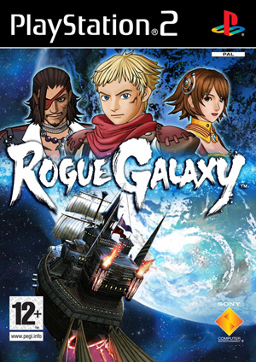
Rogue Galaxy (PlayStation 2, 2005) was Level-5's declaration of independence: its largest production to that date, built over more than three years alongside Dragon Quest VIII, and aimed openly at the two series the studio had just served. Its hero, Jaster Rogue, is a farm worker on a desert planet who gets mistaken for the galaxy's greatest bounty hunter and keeps the job. What follows is a pirate crew, a lost planet, and a galaxy rendered without loading screens.
THE MAKING
The challenge, stated by its directorThe game was first hinted at in August 2003, when Level-5 revamped its website with a single image for a New RPG; at the time, some took it for the rumored Dark Cloud 3, a rumor the record labels as exactly that. The name arrived in July 2005, when Akihiro Hino unveiled the game at the PlayStation Meeting in Tokyo and said it had been in development for two and a half years at that point, overlapping Dragon Quest VIII, and was the biggest project Level-5 had ever worked on in both production length and staff.
Hino, the game's writer, designer, producer, and co-director, stated the ambition plainly: as a creator he had always wanted to make a title as big as Dragon Quest or Final Fantasy, and believed Rogue Galaxy was on the same scale, calling it the studio's challenge to all the RPGs in the world. Producer Kentaro Motomura gave the setting's reason on the record: Level-5 was created for swords and magic fantasies, but the team had grown bored with consistently similar worlds and wanted to try something new. Hino's technical goal was personal and specific, a disc based RPG with no loading times between exploration and combat or between locations, which he described as a long time goal of his. The planets were originally planned as a virtually uncountable number, procedurally generated as the player explored; the concept was scaled back to a smaller number of hand built planets, each with multiple locations. The cel shaded look, detailed backgrounds behind smooth shaded characters, is the studio's tonal rendering again, carried over from Dark Chronicle and Dragon Quest VIII.
THE DESIGN
Seamless planets, a frog, and a flow chartRogue Galaxy plays as one continuous world: walk into enemies and the fight is already happening, in real time, with a party of three. Each character's Action Gauge drains with every action and refills over time or instantly on a successful block. Allies fight on preset strategies and will not use special moves or items unless ordered or set to, and they shout suggestions mid battle that the player can accept or ignore.
Growth runs through the Revelation Flow, a per character chart in the family of Final Fantasy X's Sphere Grid: place the required items into a group of panels and the ability or stat increase unlocks. Weapons grow on the Dark Cloud pattern, gaining experience and elemental mastery until two maxed weapons can be synthesized into a stronger one by Toady, a frog who swallows them and produces the result, keeps a Frog Log of analyzed combinations, and warns when a synthesis would make things worse. Around the main quest sit the Insectron Tournament of captured and bred battle insects, a reconfigurable Factory that turns blueprints into shop stock, challenge battles for Hunter Coins, and a hunter ranking system with purchasable mini boss quarries.
THE EDITIONS
Japan's original, and the perfected Western cutTHE RECEPTION
Praised for everything except its storyTHE LEGACY
237,631 copies in a week, and short of a millionRogue Galaxy was the top selling game in Japan in its release week, with 237,631 copies, and reached 356,192 Japanese copies by the end of 2006, with the Director's Cut adding 29,457 in 2007. Against the ambition, that was a shortfall: Sony executive Masatsuka Saeki had hoped before launch for a million units, and the game failed to meet that expectation. It was nominated for Role-Playing Game of the Year at the 11th Annual Interactive Achievement Awards, losing to Mass Effect.
No sequel followed. Rogue Galaxy stands as the largest single statement of Level-5's PlayStation 2 era, the game where the studio that had built Dragon Quest VIII for Square Enix tried to own the flagship itself, and as a useful collector's lesson in editions: the disc most Western players own is not a port of the Japanese original but a substantially expanded second version of it.
THE GAME ON THE SHELF
Rogue Galaxy · PS2