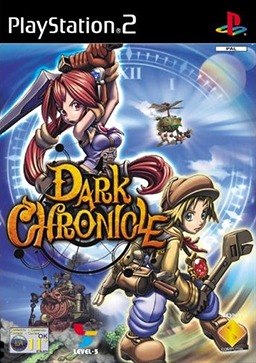
The History of Dark Cloud 2
Dark Chronicle (PlayStation 2, 2002) is the game North America knows as Dark Cloud 2. Level-5's second game took its predecessor's dungeon crawling and town building and rebuilt both around time travel: rebuild a town in Max's present and you change Monica's future, a hundred years on. The naming split was announced before release and has followed the game ever since, so this page uses both names the way the regions do.
THE NAME
Dark Chronicle here, Dark Cloud 2 thereThe game is titled Dark Chronicle in Japan and in Europe, and Dark Cloud 2 in North America. Sony Computer Entertainment set out the split at E3 in May 2002, when it announced the game for Japan and Europe as Dark Chronicle and for North America as Dark Cloud 2. It is not a sequel in cast or plot: Max and Monica are new, the story is its own, and what carries over from 2000's Dark Cloud is the machinery, Georama building, weapon growth, and procedurally generated dungeons, all of it reworked.
THE MAKING
Level-5, tonal rendering, and two yearsDark Chronicle was written, directed, designed, and produced by Akihiro Hino, with music by Tomohito Nishiura and character design by Jun Sonobe. Rumors began in April 2002 with a silhouette on Level-5's website; the full reveal came on May 16, 2002, cel shading and both protagonists included. Production took almost two years, with the CG work and the game developed simultaneously.
The look was the studio's calling card: Level-5 called its cel shading tonal rendering, smooth shaded lead characters of 2,500 to 3,000 polygons against detailed, textured backgrounds, built in Softimage 3D. Cutscenes run on the same real time models as gameplay, so costume changes carry straight into story scenes. Hino said the smooth transitions between gameplay and event scenes help increase the player's empathy for the game.
THE DESIGN
Georama, inventions, and weapons that levelCharacters do not level in Dark Chronicle; weapons do. Weapons absorb experience, gain Synthesis Points, and swallow spectrumized items to raise their stats, then evolve into stronger forms when their conditions are met. Broken weapons no longer vanish as they did in the first game; they sit unusable and lose some experience until repaired. Max fights with a wrench and a gun and pilots the customizable Ridepod mech; Monica fights with a sword and a magic bracelet and can transform into monsters.
Outside the dungeons, Geostones feed the Carpenterion, which turns them into building plans for Georama mode: place houses, trees, rivers, and recruited villagers in the past, meet each settlement's conditions, and the future changes. The third system is invention: photograph objects in the world, combine the photographs into ideas, and build what the photographs suggest. Around those pillars sit fishing and fish racing, and spheda, a golf game played on cleared dungeon floors.
THE EDITIONS
Three regional names on one disc shape, then PS4THE RECEPTION
GameSpot's best PS2 game of 2003THE LEGACY
The sequel that needs two owners to say yesDark Chronicle picked up award nominations beyond GameSpot's win, including Console Role-Playing Game of the Year from the Academy of Interactive Arts and Sciences and a BAFTA nomination for Best Adventure Game. What it never picked up was a sequel. In 2009 Level-5 manager Yoshiaki Kusuda said the studio had no specific plan but would seriously consider making one if fans asked often enough.
Hino later gave the structural reason, on the record to Polygon: the Dark Cloud license is co-owned by Sony, so Level-5 cannot produce a new Dark Cloud game on its own. The two game series sits complete on the PlayStation 2, and Dark Chronicle remains the bigger, stranger half of it.
THE GAME ON THE SHELF
Dark Cloud 2 · PS2