
The History of Clock Tower (1996)
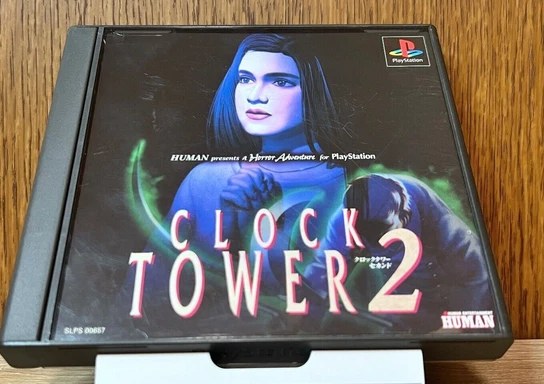
A year after the Barrows Mansion, Jennifer Simpson is in Oslo, adopted by criminal psychology professor's assistant Helen Maxwell, giving testimony about a killer who should be dead. Then the murders start again. Clock Tower for the PlayStation (1996) was Human Entertainment's first 3D game and the series' international debut, released in Japan as Clock Tower 2 on December 13, 1996, in North America on October 10, 1997, and in Europe in February 1998, because the original it follows had never left Japan.
THE MAKING
Thirty people, a new engine, and a platform gambleDirector Hifumi Kono was not interested in a sequel at first. What changed his mind was the new hardware: the technical possibilities of the next generation consoles. Choosing among them was, by his account, one of the hardest parts of the project. The Saturn was the established icon of the new generation, the PlayStation was a newcomer with an uncertain future despite an early lead, and the Nintendo 64 was on its way. He settled on the PlayStation, and in retrospect called it the best choice he could have made.
A team of about thirty people built it, and it was the first game at Human to use a 3D graphics engine, though veteran staff would rather have stayed with 2D. Kono was pleased with the engine for a director's reason: it let him use camera angles properly. Mid development, Capcom announced Resident Evil, also a horror game, with visuals that impressed the team and challenged them to push their own graphics harder. Kono described their method as material comes first, the opposite of building a system and draping material over it, and they used the 3D and animation to present their murders in both ordinary and surreal settings.
The sound design had a stated theme, noise and silence: sounds placed in obscure places, and silence left where the ear expects sound. Koji Niikura composed.
THE DESIGN
Two heroines, four scenarios, ten endingsThe game plays as its predecessor did, a point and click adventure now in 3D, by controller or mouse. Its structure is new. A prologue decides, by your actions, whether the central character is Jennifer or Helen; four scenarios follow, the cast and settings shifting with your choices; and each heroine carries five endings of her own. Between scenarios, intermissions let you explore and talk without Scissorman, the only safe rooms in the series' world.
Strength is shown in the cursor itself, white, then flashing yellow, then red. In panic mode, when Scissorman has you, only clicks on objects that will drive him off do anything at all. The Demon Idol, the clue that can end him, waits at the centre of the investigation, and the final chapter returns to a Barrows castle to use it.
THE EDITIONS
One game under two numbersTHE RECEPTION
Half a million copies, and an argument about paceCommercially there was no argument. The game sold close to half a million copies, well enough that every member of staff received a bonus (100,000 yen each), and Kono credited part of the success to Resident Evil having heated up interest in horror, and to the PlayStation itself. Critics who praised it kept returning to the same mechanism: a musical theme sounds whenever Scissorman approaches, and the tension lives in that cue. Gamezilla's Mark Skorupa compared Scissorman favourably to Freddy Krueger and Michael Myers. GameTrailers later placed the game tenth on its Top Ten Scariest Games list, and X-Play placed it eighth.
THE LEGACY
The debut the West actually gotFor most of the world this was Clock Tower, the first one, and its numbering confusion is the series in miniature: a sequel wearing a debut's name, because the debut was still behind the Japan door. The next game would complete the tangle, a spin off in Japan sold abroad as Clock Tower II.
Human made one more Clock Tower after this. Its director had run out of material, by his own account, and handed the series to a new director. That game, and the company's own ending two years later, are also on this shelf.