
Why is Scissorman so frightening?
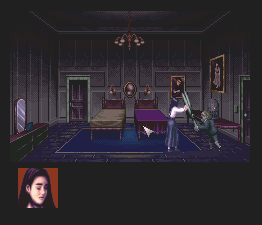
Scissorman is a nine year old boy with a deformed face and a pair of garden shears, and he has outlasted nearly every horror villain of his decade. The design record shows why, in four documented parts.
First, you cannot fight him. In the 1995 original, Jennifer has no weapons at all. Director Hifumi Kono's colleagues at Human told him a game whose protagonist runs away from the enemy would not work; he built it anyway, and the refusal became the series' identity. What you get instead of combat is panic mode: run, hide, spring the house's traps, and if he catches you, fight the controller itself, hammering a button to break free while your stamina, and her face in the corner portrait, give out.
Second, he arrives on his own schedule. He is triggered by rooms, by objects, by lingering too long, and the items you need are rearranged on every playthrough, so no memorised route makes you safe. The mansion never becomes a solved space while he is in it.
Third, you hear him before you see him. The 1995 game's music holds back until he appears. In the PlayStation sequel, critics singled out exactly this: a musical theme sounds whenever Scissorman approaches, and review after review credited the game's tension to that cue. Sound tells you the rule your eyes cannot: he is coming, and the only question is where from.
Fourth, he does not stay dead. The sequel's plot turns on his seemingly immortal state, investigated in-universe by a criminal psychology researcher. A stalker who can be killed is a level obstacle; a stalker who returns is a condition of the world. Contemporary critics placed him in the slasher pantheon on sight: Gamezilla's Mark Skorupa compared him favourably to Freddy Krueger and Michael Myers, and Next Generation wrote that even Resident Evil could not deliver the creepy feeling Clock Tower does. The scariest games lists followed, tenth for GameTrailers, eighth for X-Play, on the strength of a child with shears whom you are never, ever allowed to hit.