
The History of Crash Bandicoot
Naughty Dog's trilogy for the PlayStation (1996, 1997, 1998) made a bandicoot into Sony's unofficial mascot. The first game sold over six million copies, the second over five million, and the third nearly six million, and the third also did something no Western game had done: it became the first non-Japanese PlayStation title to sell over a million copies in Japan. This history covers all three games, because the trilogy was made as one continuous campaign by a small team working at a sprint.
THE FIRST PAIR
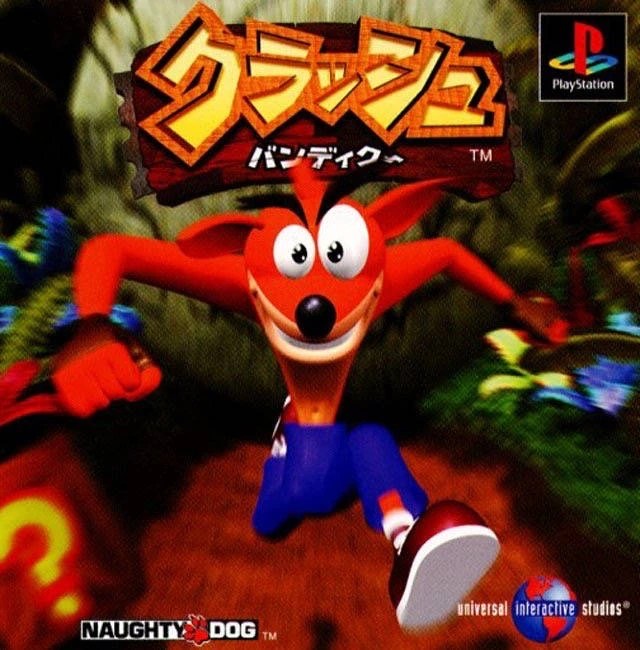
Two faces of the same bandicoot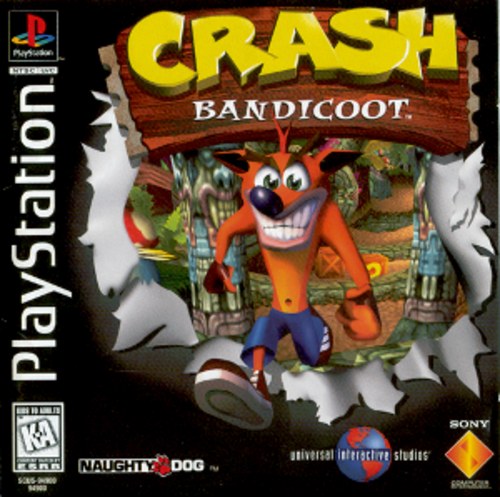
CRASH BANDICOOT (1996)
Willy the Wombat becomes a mascotSony entered the console business without a mascot, and Naughty Dog chose the PlayStation partly for that vacancy. The hero began as Willy the Wombat, designed by Charles Zembillas and Joe Pearson, and earned the name Crash from the crates he destroyed; the crates themselves were added to fill levels that felt empty, and became the series' furniture. The character model ran to 512 polygons, a technical flex for 1996. Jason Rubin directed and David Siller produced, with Josh Mancell of Mutato Muzika on music.
The game released in North America on September 9, 1996 and in Japan on December 9, 1996. Critics praised the visuals as the best on a fifth-generation console while splitting hard on the gameplay underneath: GameFan gave near-perfect scores and a Game of the Month, while GameSpot's 6.8 called the play flat, and Next Generation called it the most derivative game ever to hit a console. The market ignored the argument. By late February 1998 the game had sold 1.5 million in the United States, 725,000 in Europe, and 610,000 in Japan, where in May 1997 it became the first non-Japanese game to receive a Gold Prize for passing half a million units.
CRASH 2: CORTEX STRIKES BACK (1997)
Thirteen months, a new engine, a calmer difficulty curveThe sequel was built in thirteen months on a budget of about two million dollars, and it is substantially a Mark Cerny production: Cerny set out to design a third of the levels and ended up designing nearly all of them. A new engine, GOOL 2, ran three times faster than the original's, with ten times the animation frames and twice the polygons. The structure loosened into Warp Rooms, Crash gained the slide and the body slam, and a Dynamic Difficulty Adjustment system quietly eased the game for struggling players, a piece of user research practice the industry now teaches as a founding case.
Japan got its own edit again: a death animation in which Crash is squashed flat into a stunned head and feet was altered for the Japanese version because it resembled the calling card of a serial killer then loose in the country, a grim and very specific localisation decision. The game sold over 5.17 million copies worldwide, with about 1.3 million in Japan, making it the highest-selling Western title in Japan at the time, and reviews warmed: 89 percent at GameRankings, with the sequel's structure praised as the fix for the first game's rigidity.
CRASH 3: WARPED (1998)
Ten and a half months to a million in JapanWarped began production in January 1998 and shipped in ten and a half months, designed by Evan Wells on a budget over two million dollars. A third of the game is vehicle work, airplane, jet ski, and motorcycle, each on its own new engine, and a Relic time-trial system gave finished levels a second life. Even the small details were negotiated: Crash finally casts a real shadow because Sony's American producers were, in the recorded phrase, sick of that little discus following him around.
It sold nearly six million copies, and the Japanese figure is the trilogy's headline: Warped outsold both of its predecessors in Japan and became the first non-Japanese PlayStation game to sell over one million copies there. Three years earlier Sony Japan had nearly passed on the character. The softened face on the Japanese boxes, the softened levels behind them, and a dancing mascot on Japanese television turned a Western platformer into a Japanese fixture. The redesign that started it is documented on this shelf's Crash question page.