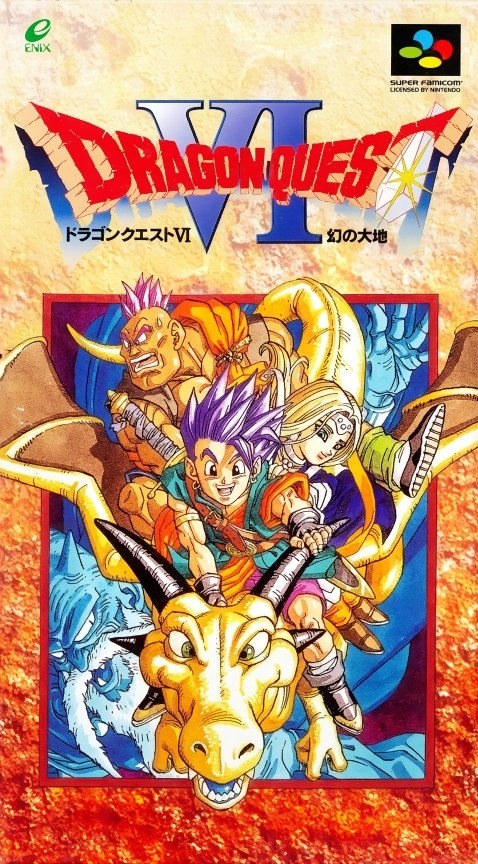
The History of Dragon Quest VI
Dragon Quest VI (Super Famicom, December 9, 1995), subtitled Maboroshi no Daichi, the Land of Illusion, closed the Zenithia trilogy that IV and V began. It was the first Dragon Quest developed by Heartbeat rather than Chunsoft, the final Dragon Quest released for the Super Famicom, and one of the best-selling games on the system in Japan, with well over three million copies sold. North America's planned Super NES version was cancelled, and the game stayed Japan only for fifteen years.
THE MAKING
A new studio takes the seriesThe founding trio stayed constant, as it had since 1986: design and scenario by Yuji Horii, art by Akira Toriyama, music by Koichi Sugiyama, published by Enix. The developer changed. Heartbeat, a studio founded by former Chunsoft staff, took over the series with VI, on a 32-megabit cartridge, at the very end of the Super Famicom's life: VI was the penultimate title released for the system.
The trilogy it completes is loose by design. IV, V, and VI share the floating castle Zenithia and themes rather than a continuous cast, so VI could open somewhere new: a village in the mountains, a hero with a sister and no past worth mentioning, and a hole in the world that should not be there.
THE DESIGN
The world above, the world belowVI is built on a pair of maps. The hero slips between the real world and a shadowy phantom world, a dreamlike reflection where places and people exist in altered form, and progress means reading both. The subtitle is literal: the second world is the land of illusion, and much of the plot is the two worlds explaining each other.
Its lasting mechanical contribution is the vocation system. At the Dharma shrine, characters take jobs that reshape their stats, and skills are earned by fighting battles against enemies strong enough to teach something; grinding slimes does not advance a vocation. The system proved durable enough to be carried into Dragon Quest VII. Monster recruitment, V's invention, returns here through a vocation skill, the Beastmaster's, rather than by default.
THE EDITIONS
The trilogy's missing chapter, for fifteen yearsTHE RECEPTION
A giant at home, an absence abroadTHE LEGACY
The system that stayed, the trilogy completedVI's vocation design is the thread that runs forward: VII rebuilt itself around jobs, and the idea of skills earned through vocation mastery recurs across the later series. Its two-world structure, a real world and its dreaming double, became one of the series' recurring devices as well.
For collectors the game's shape is its story: a three-million-selling Japanese hit with no Western Super NES edition at all, not a rare one, a nonexistent one. Every English copy in the world is a DS or mobile descendant. The Super Famicom box is the only original there is, which is precisely the kind of gap this Library exists to document.