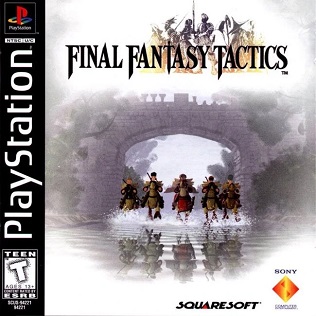
The History of Final Fantasy Tactics
Final Fantasy Tactics (PlayStation, 1997) is framed as a recovered history: the Lion War as the records tell it, and the commoner the records buried. It was Yasumi Matsuno's first game at Square, the debut of the world of Ivalice, and a tactical RPG whose subject is class. It sold over a million copies in Japan in its first year and became, slowly, one of the most argued for games in the whole franchise.
THE MAKING
Quest to Square, 1993 to 1997The idea began in 1993 with series creator Hironobu Sakaguchi, a fan of tactical RPGs who conceived a strategy Final Fantasy but had no time to build it. Production finally began at the end of 1995 under Matsuno, who had resigned from Quest Corporation after finishing Tactics Ogre: Let Us Cling Together and brought several of its staff with him: composer Hitoshi Sakimoto and artists Hiroshi Minagawa and Akihiko Yoshida among them. Sakaguchi produced; Hiroyuki Ito designed the battles.
Matsuno's stated wish was an accessible tactical game with a storyline about class based conflict and the rewriting of history. Ramza Beoulve, a highborn cadet, fights through the Lion War between two noble factions, and the narrative frame, a historian reading the Durai papers centuries later, announces from the first screen that the official story is the lie the game exists to correct.
THE DESIGN
Isometric fields and the job system at warBattles play on small isometric 3D fields that rotate, with height, facing, and charge time governing everything. Units are built from the series' deepest job system: some twenty jobs, from Squire and Chemist up through Knight, Summoner, and Mime, with abilities mixed across jobs so a unit is an argument about preparation. Permanent death is real: a fallen unit left unrevived for three turns is gone.
The story runs on the same machinery as the battles. Nobles and commoners use the same job system and are separated only by what the world hands them, and Matsuno has said the class theme reflected what he saw around him, including inside his new company. The Zodiac Brave Story's church, its heresy trials, and its saint who may be a demon were daring material for a game with Final Fantasy on the box in 1997.
THE EDITIONS
One game, three English livesTHE RECEPTION
Acclaim that compoundedTHE DISSENT
Kept, as printedTwo documented criticisms followed the game west. The first is difficulty and opacity: the job system's depth arrives with little teaching, and a handful of story battles can end an unprepared save outright, a design the remakes have kept debating. The second is the one this Library documents on its own page: the original English translation, produced quickly, with errors that became famous in their own right, lines mangled badly enough that one orders the player to defeat a character's elder brother who is, in the scene, that character. The 2007 retranslation exists because the 1998 script needed replacing; whether the replacement's elevated register improved it is the argument the question page lays out.
THE LEGACY
Ivalice, and the long vindicationTactics founded more than a subseries. Its world became the Ivalice of Vagrant Story and Final Fantasy XII, its team became Square's prestige unit, and its Advance and A2 sequels carried the name to handhelds. The Ivalice Chronicles' million copies in 2025 prompted Matsuno to admit, publicly, that he had underestimated the original's expected sales all along, predicting 800,000 to a million over three years for a game that did that in Japan in year one. The buried history outlasted the official one, which is the game's own plot, happening to its makers.
THE GAME ON THE SHELF
Final Fantasy Tactics · PlayStation