The History of Gex
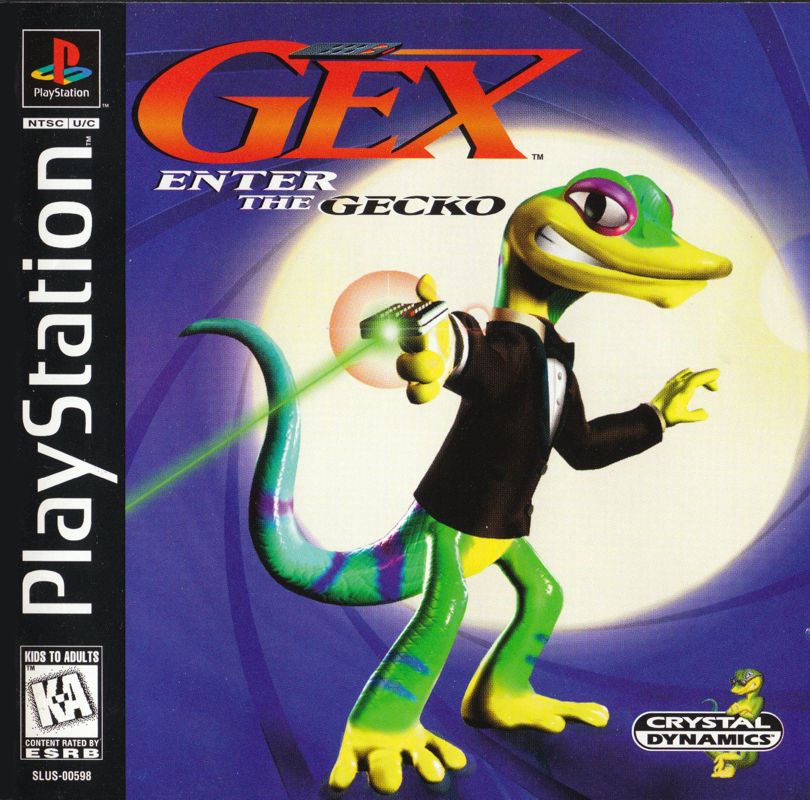
Gex (3DO, 1995) introduced a television obsessed gecko voiced by comedian Dana Gould, who never stops wisecracking as he crosses the Media Dimension to escape the overlord Rez. Crystal Dynamics built him to rival Mario and Sonic, and on the 3DO he came close enough to matter: the game sold past a million copies on a dying console, became a pack-in title, and carried the character to the PlayStation and Saturn. Three years later Gex: Enter the Gecko (1998) rebuilt him in 3D, and it is that second game this shelf pairs with the PlayStation 2 heroes in the gallery.
THE MAKING
Gecko X becomes Gex, 1993 to 1995Creator Lyle Hall began the project shortly after joining the newly formed Crystal Dynamics in 1993, aiming at a 2D platform game starring the coolest character he could come up with, built to show off the 3DO's graphics and CD audio. The first concept was a Hollywood stunt performer named Gecko X, saving his film studio from bankruptcy across genre themed stages introduced by stock footage. Lead programmer Gregg Tavares argued the realistic settings would break the level design, and the concept was rebuilt into something more fantastical: a villain, first named Rezull and then Rez, drags the gecko into a television world he must escape by collecting magic remotes.
The team was tiny, at first four people, and the expanded memory and storage of 32-bit CD hardware made art production far slower than the 16-bit years had trained anyone to expect: a single level's art could take two months. Panasonic, expecting platformer art to be cheap, resisted adding artists. The game missed a June 1994 deadline, then a September one, lost its science fiction world and its extra art sets, and shipped after 21 months of development.
Inside that pressured production sits the series' best story. A group of developers, Evan Wells among them, secretly programmed extra features into the game on their own initiative: secret levels built from the scrapped science fiction art, a small shooting game Wells had written as a Stanford senior project, and an extended end credits sequence, 18 minutes of staff photos, concept art, and storyboards, hidden behind full completion. Playtesting discovered the additions, and management kept them in the game.
THE VOICE AND THE 3D TURN
Gould, then Mario 64 changes everythingGex talks because CD storage let him. Dana Gould voiced the character and wrote all of his dialogue in the first game, a comedian's one liners fired constantly as the gecko climbs walls and ceilings on his suction cup feet, whips his tail, and eats power-up flies with his tongue. Contemporary reviewers singled the voice out as the first time a game character had been given a voice and personality that actually worked. The same voice is why a hero on a neighboring shelf in this gallery has none: Naughty Dog's Jason Rubin kept Jak silent and cited Gex as his prime example of the risk.
The sequel began, in early 1997, as another 2D game. Lead programmer Adrian Longland recalled that three months in, E3 reset the brief: Crash Bandicoot showed 3D could work on the PlayStation and Mario 64 showed the open world, so the two ideas were put together for Gex. The character was rebuilt on a full skeletal system, with more bones than a real gecko and skin stretched over them, so his mouth could move with the dialogue. Simpsons writer Robert Cohen worked on the script, Gould recorded over 700 voice lines, and the Nintendo 64 port, squeezed onto a cartridge, cut more than 500 of them. Enter the Gecko reached the PlayStation on February 24, 1998.
THE EDITIONS
3DO first, then everywhereTHE RECEPTION
Praise, and an honest sales disputeWhichever contemporary count is closer, Gex was one of the best selling games on the 3DO and Crystal Dynamics' mascot for a time, headlining three games in four years. The studio's later fame belongs to other heroes, but the gecko's 2025 return in the Gex Trilogy suggests the wisecracks aged better than the console that launched them.
THE GAME ON THE SHELF
Gex: Enter the Gecko · PlayStation