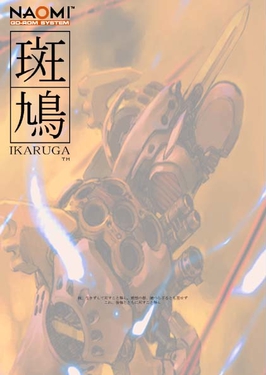
The History of Ikaruga
Ikaruga (arcade December 20, 2001) is Treasure's polarity shooter, the spiritual sequel to Radiant Silvergun, directed and scored by Hiroshi Iuchi with art by Yasushi Suzuki. Its ship switches between black and white, absorbing same color bullets and dying to the opposite.
THE MAKING
Project RS2, built after hoursIkaruga began as Project RS2, a direct sequel to Radiant Silvergun that became a spiritual one, while Treasure's main resources were busy on Sin and Punishment. Director Hiroshi Iuchi built the prototype at home, in his spare time, with programmer Atsutomo Nakagawa, reusing Radiant Silvergun sprites to move fast. The polarity idea came from Treasure's own Silhouette Mirage (1997), and Iuchi also drew on the defense system of Shinrei Jusatsushi Taromaru (1997). The finished game took five Treasure staff plus three support staff from G.rev. Iuchi composed the music himself, pacing stages on a mountain and valley pattern of peaks and melancholy.
The prototype limited the player's ammo, refilled by absorbing bullets. Playtesting found the pauses weak, so unlimited fire became the standard game and the ammo rule survived as the unlockable Prototype mode.
THE DESIGN
Be the color of the bulletsEverything on screen is black or white. Tap a button and the ship flips polarity: absorb bullets of your own color, die to the other. Absorbed fire charges a homing laser, up to twelve levels strong. Shooting an enemy of the opposite color does double damage; killing one of your own color releases energy that can kill you if you flip carelessly. Scoring chains run in threes, 100 points doubling up to 25,600, and the stages were deliberately redesigned so the optimal scoring route is hard to read. The difficulty is not dodging. It is deciding, several times a second, what color to be.
THE RELEASE
The import that forced a Western editionArcade, Japan, December 20, 2001, on Sega NAOMI. Dreamcast, Japan only, September 5, 2002. Import players built a cult around it before any Western publisher moved. Infogrames then took the GameCube version worldwide under the Atari brand: Japan January 16, 2003, North America April 15, 2003, Europe May 9, 2003. Iuchi recorded the strange first reaction honestly: arcade players praised the looks and music, divided on the system, and told him this is not an arcade game, make it more thrilling and fast paced. Later ports reached Xbox 360 (2008), Windows (2014), Switch and PlayStation 4 (2018).
THE RECEPTION
85 on Metacritic, 36 in FamitsuTHE GAME ON THE SHELF
Ikaruga · Arcade, Dreamcast, GameCube