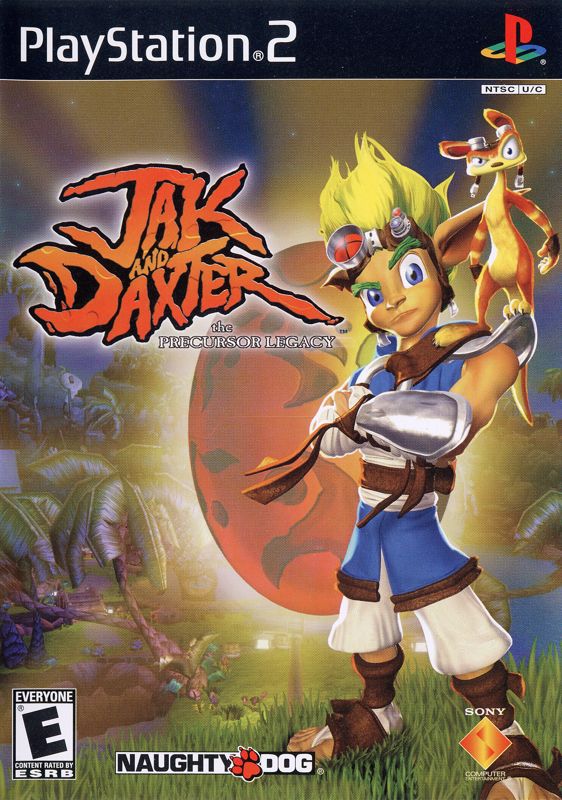
The History of Jak and Daxter: The Precursor Legacy
Jak and Daxter: The Precursor Legacy (PlayStation 2, 2001) was Naughty Dog's first game after Crash Bandicoot and the PlayStation 2's defining early platformer: a single connected world a player could cross end to end without a single loading screen, at a time when loading was the tax every big game charged. It scored a 90 on Metacritic, sold over a million copies in its first stretch, and passed two million in the United States alone by 2007.
THE MAKING
Project Y, 1999 to 2001The project began in 1998 and January 1999, under the codename Project Y, while the rest of Naughty Dog finished Crash Team Racing, the studio's last Crash Bandicoot game. Co-founders Jason Rubin and Andy Gavin were disenchanted with building a character they did not own: Crash belonged to Universal Interactive. Their vision for the new game braided three models together, the platforming of Banjo-Kazooie, the epic storytelling of The Legend of Zelda, and the do-or-die excitement of Crash itself.
The team, which grew to 36 people by January 2000, built a new engine and a new programming language for it: GOAL, Game Oriented Assembly Lisp, designed by Gavin so code could be changed in real time, cutting iteration times sharply against the Crash years. Animators were recruited from Disney and Nickelodeon, and the animation department became the studio's biggest. In early 2001 Rubin and Gavin sold Naughty Dog to Sony, a sale rooted in the same frustration over Crash, and the game was finished on a $14 million budget with the final boss integrated just 48 hours before submission.
The hardware itself was a heist story. The PlayStation 2 was difficult to program for and examples were scarce, so Naughty Dog secured an early devkit in 1999, brought into the United States around export restrictions, and began engine work on incomplete hardware.
THE DESIGN
650 concepts, one ottselCharacter designer Charles Zembillas, who had drawn Crash Bandicoot, worked in a private workspace for a year and produced some 650 concepts before Jak settled into his long eared, elfin final form. A planned third main character, a pet that would evolve with the player's actions in the manner of a Tamagotchi, was cut so the studio could concentrate on two: Jak, silent and athletic, and Daxter, the loquacious ottsel, an otter and weasel hybrid inspired in part by Mushu from Mulan, who supplies the commentary Jak never gives. The silence was a deliberate rule, and this Library tells that story on its own page.
The design drew on Western and Eastern sources together: Joe Madureira's Battle Chasers, Hayao Miyazaki's Nausicaa of the Valley of the Wind and Princess Mononoke, and Asterix in the village life, with art director Bob Rafei naming Star Wars, Disney, and Studio Ghibli as touchstones. Technically, the world holds together through streaming: roughly nine specialized renderers, rewritten repeatedly to hold 60 frames per second, and a tessellation scheme that reduces distant objects to simple shapes, a smooth sphere becoming a cube at 200 yards, so the horizon the player sees is always really there.
The sound of the game is a production story of its own. The score was composed by Josh Mancell and produced by Mark Mothersbaugh. The game was recorded in six languages with 126 voice actors, Max Casella as Daxter and, as the villain Gol, Dee Snider of Twisted Sister. It was all done after the original sound programmer quit early and was never replaced, a gap the team later said cost the audio its cohesion.
THE EDITIONS
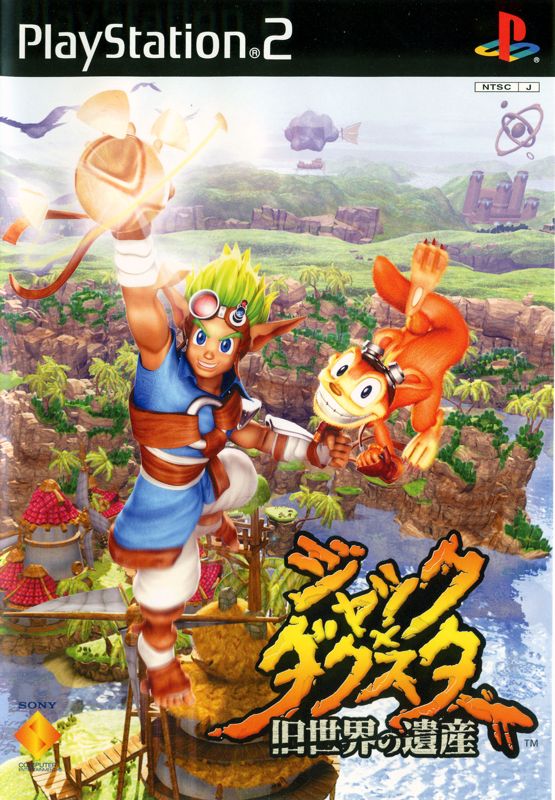
West first, Japan the same monthTHE RECEPTION
Praise, with the dissent keptThe commercial story matched the reviews. The game passed one million copies worldwide by 2002 and reached 2.01 million in the United States alone by December 2007. It made Jak a PlayStation mascot beside the heroes of the two studios working across the hall and down the road, Insomniac and Sucker Punch, whose own shelves stand next to this one in the gallery.
THE GAME ON THE SHELF
Jak and Daxter: The Precursor Legacy · PlayStation 2