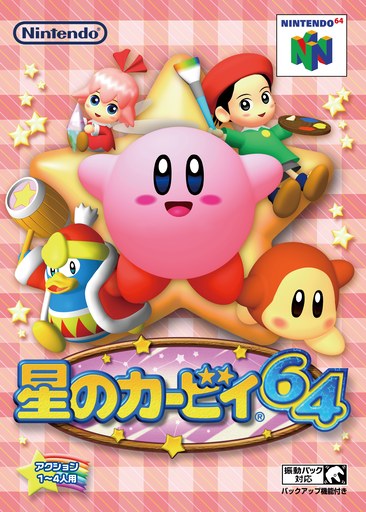
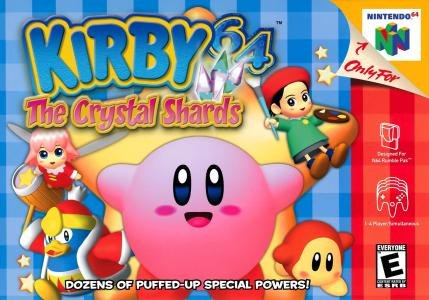
The History of Kirby 64: The Crystal Shards
Kirby 64: The Crystal Shards (Nintendo 64, 2000) is the first Kirby game with 3D graphics, played as a 2.5D side-scroller. Dark Matter shatters Ripple Star's sacred crystal into shards across six planets, and Kirby, the fairy Ribbon, and eventually Adeleine, Waddle Dee, and King Dedede set out to reassemble it. Its invention is the Power Combo: swallow or combine two copy abilities and they fuse into something stronger, 28 combinations from a base of seven.
THE MAKING
A 64DD game, saved by a cartridge and a control changeDevelopment began in September 1997 under director Shinichi Shimomura, who had directed Dream Land 2 and 3, and the game was first built for the 64DD, Nintendo's disk drive add-on. When the add-on failed commercially, the game became a standard cartridge release. Sakurai, the series' creator, had little involvement and deliberately avoided playing it during development, so his comments would not pull against HAL's vision.
The prototype controlled Kirby with the analog stick and was, by project manager Takashi Saito's account, nearly finished and pretty good. Watching children struggle with the stick and the essential Z button at Space World 1999 convinced the team to rebuild the controls around the D-pad about a year before release, the right call for a game played on a 2D plane. Several playable characters were cut along the way; only Kirby, and Dedede as a rideable partner in set levels, remained. Nintendo spent $4 million marketing the result.
THE DESIGN AND MUSIC
Combos by design, jazz by surprisePower Combos were conceived as an experiment: what happens if copy abilities mix? Saito noted the system tunes the difficulty by playstyle, since leaning on combos makes the game harder and ignoring them keeps it gentle. All the crystal shards are the real completion gate; several require specific combos, and only a full set opens the true final boss and ending.
Jun Ishikawa and Hirokazu Ando composed the soundtrack, with synth-pop and techno influences. Ishikawa spent about a year on most of the music and scored the final areas as jazz to surprise players. Late in development he learned of a boss he had not been told about and composed its track in a hurry from samples of finished songs: a minimalist drum and bass piece with no melody, which the boss's designers loved.
THE RECEPTION
Colorful, classic, and called shortTHE LEGACY
The last of the old line, for eleven yearsKirby 64 was the last traditional Kirby home console game until Kirby's Return to Dream Land in 2011, an eleven year gap that makes it the closing chapter of the series' first era. It was re-released on the Wii Virtual Console in 2008, the Wii U in 2015, in Kirby's Dream Collection in 2012, and on Nintendo Classics in 2022, where its picture book pastel look has aged better than most of its polygon contemporaries.
THE GAME ON THE SHELF
Kirby 64 · Nintendo 64