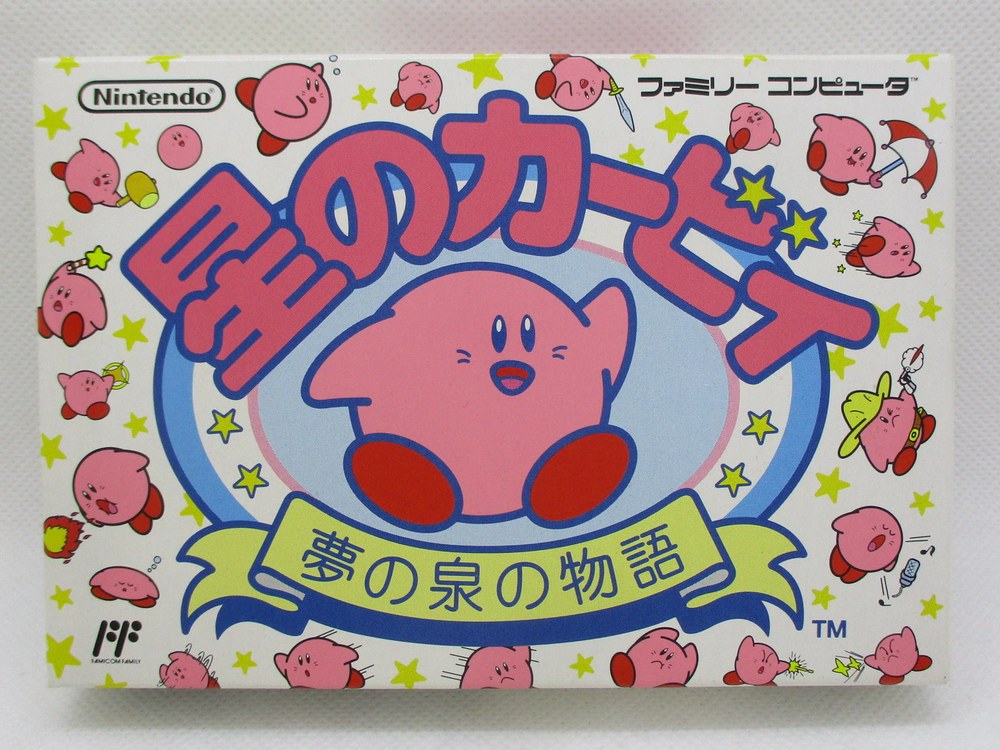
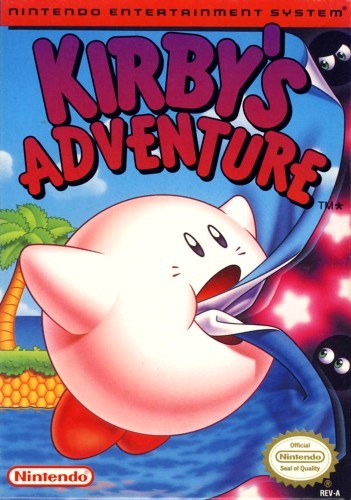
The History of Kirby's Adventure
Kirby's Adventure (NES, 1993) sends Kirby across seven worlds to rebuild the Star Rod after King Dedede breaks it into pieces. The twist waits at the end: Dedede broke it to seal away Nightmare, who had corrupted the Fountain of Dreams, and Kirby has spent the game undoing the seal. It introduced the copy ability, the first appearance of Meta Knight, and the first Kirby the world could see in pink.
THE MAKING
A port that became a new game, late in the NES's lifeDevelopment began in 1992 at HAL Laboratory in Kofu, when Sakurai was asked to port Kirby's Dream Land to the NES. He chose to make a new game instead: the Game Boy title had aimed at beginners, the NES audience was more experienced, and, in his words, when it came to capacity and what was possible, everything expanded greatly with the NES. He returned as director and designer, with Satoru Iwata, Shigeru Miyamoto, and Takao Shimizu producing, and Iwata also assisting with programming.
The game shipped in Japan on March 23, 1993, in North America that May, and in Europe on September 12, ten years after the Famicom launched and well into the 16-bit era. It still topped the Famitsu sales chart in Japan in May 1993, proof the old machine's audience had stayed for the right game.
THE DESIGN
Forty abilities enter, twenty-five shipKirby's Dream Land had been criticized by experienced players for its simplicity, so Sakurai kept the simple core and added depth on top of it. The result was the copy ability: swallow certain enemies and Kirby takes their power, fire, sword, cutter, and more. HAL created over forty candidate abilities and kept their favorites, twenty-five in the finished game. Taking a hit knocks the ability loose as a bouncing star the player can recover, a small drama in every fight.
Supporting changes ran everywhere. Kirby could now run and perform a slide attack, his spit grew stronger when he inhaled several objects at once, and his sprite was made larger after players found the Game Boy Kirby too small. Minigames were added on purpose, as a pressure valve, so the expanded moveset would not make the game feel forbidding. Backgrounds began as pictures drawn by an artist and handed to the mapper to build, which Saitou said were meant to be pretty enough to look at on their own.
And for the first time, Kirby was pink on screen. Sakurai had always intended pink; the Game Boy simply could not show it, and several staff were shocked when the NES game revealed the color. The music is by Hirokazu Ando, who would become, with Jun Ishikawa, one of the series' two defining composers.
THE EDITIONS
Remade, flattened into 3D, and kept in printTHE RECEPTION
The NES, squeezed beautifullyTHE LEGACY
The formula, completedAdventure is where the modern Kirby formula locks into place: copy abilities as the series' signature, Meta Knight as its recurring rival, Kirby established in pink on every region's box, and a structure of worlds, lobbies, museums, and arenas that later games kept expanding. Reviewers then and now treat it as the improvement on the original in every direction the original left open, which is exactly what Sakurai built it to be.
THE GAME ON THE SHELF
Kirby's Adventure · NES