The History of Mother
Mother reached the Famicom on July 27, 1989, developed by Ape Inc. and Nintendo. It is an RPG with no swords, no dungeons, and no medieval anything: a boy named Ninten, a baseball bat, a psychic gift, and a late twentieth century America that its writer, the copywriter Shigesato Itoi, invented from the outside. It sold around 400,000 copies in Japan. Its American version was finished, and never released, for twenty six years.
THE MAKING
The pitch that made its author cry on the trainItoi came to games as a fan: a colleague introduced him to Dragon Quest, and while playing Dragon Quest II he conceived an RPG set in contemporary times, a period he knew, where the medieval settings of Final Fantasy and Dragon Quest were foreign to him. Nintendo's president Hiroshi Yamauchi had noticed Itoi defending video games on a late night talk show, and Itoi, visiting Nintendo on other business, pitched his idea, then titled ESP1, to Shigeru Miyamoto.
Miyamoto liked the ideas and reacted with indifference. He was not sure a celebrity copywriter could pull it off, explained that game concepts needed people who signed on to make the product, and asked Itoi to start over and make it simpler. Itoi kept his composure in the room and cried from helplessness on the bullet train home. Then Miyamoto called: he had found a development team. Production began in Ichikawa a month after the green light, with Itoi cutting back his day job, and Miyamoto producing.
THE DESIGN
A parody that plays its model straightMother is modeled on Dragon Quest's gameplay, first person menu battles, random encounters, experience and levels, and it subverts everything around that skeleton. Health comes back at hospitals, saves are made by phoning your father, money sits in an ATM account he fills, and the weapons are baseball bats, toy guns, and frying pans, because the natural limits of daily life are the design problem Itoi pitched: children cannot simply be given firearms, and daily life has no pretense for magic, so the powers are psychic, PSI, inherited from a great grandfather who studied them after an alien abduction took his wife.
The world is one connected map rather than a set of separated locations, drawn in an oblique projection Itoi requested, and the enemies are the setting's joke and thesis at once: hippies, zombies, possessed objects, runaway vehicles, brainwashed animals. Under the parody sits a genuinely tender story about a stolen lullaby: eight melodies, gathered across America, sung at the end to an invader, Giygas in later spelling, who was raised by the hero's own great grandmother and can be defeated only by being reminded of her love.
THE EDITIONS
The versions, documentedTHE RECEPTION
Scores, sales, and the dissentThe sequel is widely considered the better implementation of the same ideas, and this Library's EarthBound shelf tells that story. But the ideas, modern setting, psychic children, humor with a funeral underneath, were all here first.
THE LEGACY
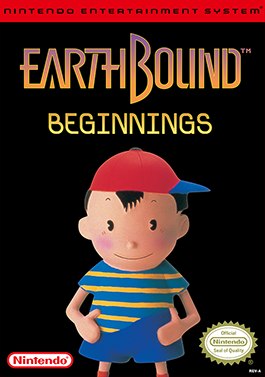
What it left behindMother built the strangest afterlife in this gallery: a finished English version that existed only as a rumor and a ROM, a fan culture that kept the series alive through two decades of American silence, and an eventual official release under a third name, EarthBound Beginnings, twenty six years after the Famicom original. Itoi's series went on to Mother 2, which America knows as EarthBound, and Mother 3, which America still knows only by reputation.
THE GAME ON THE SHELF
Mother · 1989