
The History of Panzer Dragoon Saga
Panzer Dragoon Saga (Sega Saturn, 1998), released in Japan as Azel: Panzer Dragoon RPG, is the third Panzer Dragoon game and the series' only role playing game: four discs, a single playable character, an invented language, and a battle system built around a dragon that changes shape. It is a Saturn exclusive to this day, the highest rated game on the system by the era's review indexes, and the most expensive mainstream Saturn title in English.
THE MAKING
Team Andromeda, 1995 to 1998Development began in early 1995 inside Team Andromeda, alongside the rail shooter Panzer Dragoon II Zwei. Director Yukio Futatsugi and designer Manabu Kusunoki led a staff of around forty, twice the size of Zwei's team, working with that game's engine and Softimage tools while writing their graphics code from scratch, without libraries. Futatsugi later said the game would have been impossible on the PlayStation. Sega's brief was explicit: an RPG that could compete with Final Fantasy VII, with a sales target of 1.5 million copies. The schedule slipped into 1998, partly to keep clear of Game Arts' Grandia.
The cost is part of the record. Two members of the development staff died during production, one in a motorcycle accident and one by suicide, losses Futatsugi attributed to the stress of the working conditions. Team Andromeda disbanded after release; much of the staff regrouped at Smilebit, which made Panzer Dragoon Orta in 2002.
The world the artists built drew on named influences (Tier 1, from the team's own accounts in the oral history record): Hayao Miyazaki's Nausicaä, Neon Genesis Evangelion, Star Wars, and the art of Jean Giraud, Moebius. Artist Katsumi Yokota has said Azel's jacket was inspired by British mod fashion, by way of Quadrophenia. The cutscenes speak Panzerese, a fictional language assembled from Greek, Latin, and Russian elements; the English version kept the Japanese voice performances and subtitled them. Composers Saori Kobayashi and Mariko Nanba generated much of the score through the Saturn's own PCM sound hardware. When Brave Wave rearranged the soundtrack in 2018, it worked from recordings, because the original sequencer data had been lost.
THE DESIGN
One rider, one dragon, three gaugesThe story is deliberately small: Edge, a young mercenary, and Azel, the girl he rescues and pursues, in a cast kept tight on purpose. Edge is the only playable character, and the campaign runs under twenty hours. To keep a solo party deep, battle designer Akihiko Mukaiyama, brought in from work on Sakura Wars, built combat around positioning: the dragon circles enemies through quadrants, safe and dangerous zones shifting as the fight moves, while three action gauges fill and are spent on attacks, items, and berserk techniques. Between battles the dragon morphs, its stats and form reshaped by the player's choices, the mechanical substitute for a party.
The English script carries its own footnote. Localizer Chris Lucich and his team were given incomplete translations to work from and embellished where the material ran out, a gap the finished localization wears openly.
THE EDITIONS
Three boxes, one printing eachAzel in Japan, Saga in the West
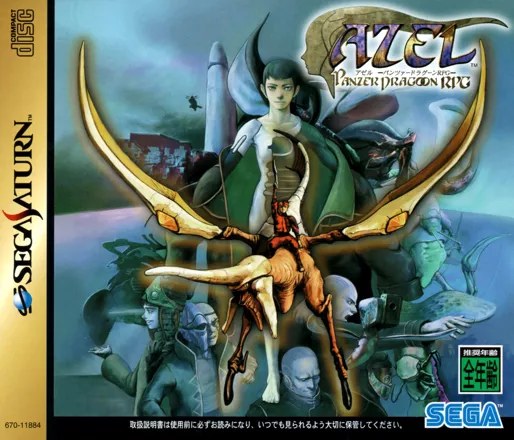
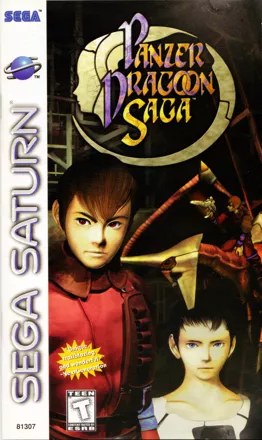
Europe's edition (April 17, 1998) came in the PAL outer box with the same key art. There has never been another edition: no port, no remaster, no digital release, on any platform, in any region.
THE RECEPTION
The highest rated game on the systemEdge magazine scored it 9 of 10 and Game Informer 9 of 10, calling it "easily the best Saturn RPG." The game was nominated at the 2nd Interactive Achievement Awards for Console RPG of the Year and Console Game of the Year. The dissent is consistent and kept here: reviewers found it short, found its puzzles too easy, and GamePro objected to the subtitled, undubbed English presentation. Next Generation's four of five stars carried the same reservations in politer form. Nobody disputed the craft; the argument was about length and difficulty, and it has never really stopped.
THE LEGACY
The price is the epilogueThe afterlife is list after list: IGN named it the greatest Saturn game in 2008, 1UP put it first among cult classics in 2005, and Game Informer counted it among the most essential rare RPGs in 2006. English copies sell for hundreds of dollars and sealed copies for over $1,000, against a Japanese edition that asks a fraction of that and cannot be played in English at all. Saga is the rare case where the collector story and the critical story are the same story: a game built to sell a million and a half copies, printed in the low tens of thousands, and reviewed like a masterpiece by the few who could find it.