The History of Paper Mario: The Thousand-Year Door
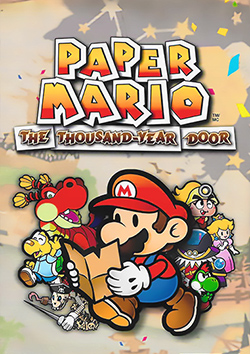
Paper Mario: The Thousand-Year Door (GameCube, 2004) was developed by Intelligent Systems and published by Nintendo. It was directed by Ryota Kawade, produced by Shigeru Miyamoto and Ryoichi Kitanishi, written by Hironobu Suzuki and Misao Fukuda, drawn by Chie Kawabe, and scored by Yoshito Hirano and Yuka Tsujiyoko. Mario comes to the port town of Rogueport chasing a treasure map Princess Peach mailed him, finds her kidnapped by the X-Nauts, and goes collecting the seven Crystal Stars that open a door sealed for a thousand years.
THE MAKING
Announced at GDC, previewed at E3Nintendo revealed the game at the Game Developers Conference of 2003, as a direct sequel to the Nintendo 64's Paper Mario. It carried working names to match: Mario Story 2 in Japan, where the series keeps the Mario Story name, and Paper Mario 2 in North America. The E3 2004 preview put Hooktail Castle and a Bowser bonus level in players' hands, and the finished game shipped that summer in Japan under its final Japanese title, Paper Mario RPG.
Intelligent Systems kept the predecessor's structure and rebuilt its presentation of battle. The team that made it was, notably, the same studio building Fire Emblem: Path of Radiance for the same console in the same years; this Library's GameCube shelf holds both, and they could hardly be less alike.
THE DESIGN
A stage, an audience, and a paper heroCombat happens on a stage in front of a live audience, and the audience is a system: perform well and it grows, from fifty seats toward two hundred, cheering Star Power back into Mario's special moves; bore it and it throws rocks or leaves. Attacks and guards run on timed button presses, the series' Action Commands, and badges spend Badge Points on permanent builds. Between chapters the game hands the controller to Peach, held on the X-Nauts' moon base and teaching their computer, TEC, what love is, and to Bowser, stomping through side-scrolling levels in parody of his own series.
The paper is mechanical, not just visual. Mario is cursed, gratefully, with transformations: fold into a paper airplane, a boat, a tube. Seven partners rotate through the second slot, each with a field skill the puzzles require, from Goombella's enemy profiles to a baby Yoshi the player names. Rogueport itself is the hub, a genuinely seedy port town built over a sunken city, and the writing keeps its edge for twenty years of readers.
THE EDITIONS
One original, then the remakeTHE RECEPTION
87, and the award to prove itTHE SALES AND LEGACY
1.91 million, then twenty years of comparisonThe game opened at number one in Japan with about 159,000 copies in its first week, sold 409,000 there in total and 1.23 million in North America, reaching 1.91 million worldwide by December 2007. Solid numbers, not phenomenon numbers; the reputation did the compounding. Edge placed it 93rd in its 100 best games in 2007, and it is routinely named not just the best Paper Mario but one of the best Mario RPGs and one of the best games on the GameCube.
Its strangest legacy is the shadow it casts forward. Every later Paper Mario is reviewed against it, usually unfavorably, and Nintendo's own answer, two decades on, was not a new formula but this game again, rebuilt. The remake outselling the original's pace in its first month is the market agreeing with the critics of 2004.
THE GAME ON THE SHELF
The Thousand-Year Door · GameCube