
The History of Persona 2
Persona 2 is a duology told from two sides of the same crisis in Sumaru City: Innocent Sin (1999), following high schooler Tatsuya Suou, and Eternal Punishment (2000), following reporter Maya Amano through the same events from an adult's vantage. Japan received both. The West received only Eternal Punishment on the PlayStation, and Innocent Sin, the first half of the story, stayed in Japan for twelve years. This page treats the pair as one record, because that is how they were made.
THE AMERICAN BOX
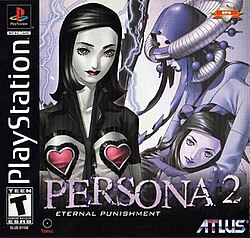
The Innocent Sin Japanese box was not verified to the Library's standard in this pass and is a named gap. There is no Western PlayStation Innocent Sin box to picture: none was ever made, which is the subject of the question page linked below.
THE MAKING
Written as one story, from two viewpointsMost of the first game's staff returned, under producer Kouji Okada, writer Tadashi Satomi, and artists Kazuma Kaneko and Shigenori Soejima. The mixed navigation of Persona 1, criticized for slow dungeon crawling, was replaced by a unified overhead view, and the series dropped the Megami Ibunroku banner title to stand apart from Megami Tensei. Innocent Sin's theme is teenagers growing through trouble; its masked villain, the Joker, and its Lovecraft borrowed god Nyarlathotep carry that theme into horror.
Eternal Punishment exists because of a writing decision documented in its development: while scripting Innocent Sin, Satomi felt the story also needed an alternate viewpoint, and the sequel was built to give it one, following the adult characters and asking how grown-ups, not students, meet the same crisis. The two games share an engine, a city, and a cast, with the second expanding the first's systems. Atlus originally hoped to fit both PSP remakes on a single UMD; the games would not fit, and they shipped separately.
THE DESIGN
Rumors become realThe duology's signature system is the Rumor system: in Sumaru City, rumors spread widely enough become reality, the power of words made mechanical. Players collect rumors from townspeople and pay a detective agency to spread the useful ones, turning up weapons that should not exist and events that never happened. Battles add Fusion Spells, combined Persona attacks triggered by specific skill sequences, and the demon conversation system returns, trading talk for the tarot cards that fuel fusion.
Eternal Punishment refines rather than replaces: a reworked Persona creation system, an improved Rumor system, shops that sell spell cards, and Fusion Spells that can be registered for reuse. The duology also quietly widened who these games could star: Eternal Punishment's lead is a working adult woman, and Innocent Sin includes a same-sex romantic option for its lead, both unusual for the genre and the year.
THE EDITIONS
The pair, and the halvesTHE RECEPTION
Strong scores on both halvesAtlus's own localization record frames the pair: after the heavy edits of Persona 1, the company resolved to stay as faithful as possible for Eternal Punishment, keeping only Persona 1's established Western names for returning characters, a position Atlus itself calls the halfway point in its localization history. The reprint of 2008, the PSN release, and the PSP remakes kept the pair in print somewhere almost continuously; only the halves kept changing places.
THE LEGACY
The pair as the series' hingePersona 2 closed the series' first era: the occult, rumor driven, adult cast experiments it ran were set aside when Persona 3 rebuilt the formula in 2006, and the duology's reputation has since grown into the franchise's cult core, the games its longest fans cite first. Its Western history is also a document of how localization decisions get made, by content, by staffing, and by timing, which is why the missing first half gets a question page of its own, linked below.