
The History of Revelations: Persona
Revelations: Persona (PlayStation, 1996) was Atlus's attempt to turn its dense occult RPG line toward a new audience: students at St. Hermelin High, a media conglomerate's dimensional accident, and demons negotiated with as often as fought. It was the first role-playing Megami Tensei game released in the West, and its 1996 American edition changed names, hair, ethnicities, and cut an entire second campaign. The faithful version Western players know today arrived thirteen years later, on PSP.
THE AMERICAN BOX
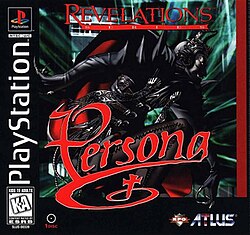
The Japanese Megami Ibunroku Persona box was not verified to the Library's standard in this pass and is a named gap. The rename on this box is part of the record: Atlus USA chose Revelations because the team thought it sounded cool, a banner it hoped would define its own identity beside Final Fantasy and Suikoden.
THE MAKING
From Shin Megami Tensei If... to a series of its ownDevelopment began in 1994 after Shin Megami Tensei If..., whose high school setting had been received so positively that Atlus spun off a dedicated subseries about the inner struggles of young adults, using the term Persona for the inner selves the students summon into battle. Writer Tadashi Satomi spent about a year on the script, through roughly twenty drafts; director Kouji Okada and artists Kazuma Kaneko and Shigenori Soejima led the team, and the Persona system grew out of If...'s Guardian mechanic, designed by Katsura Hashino.
The sources on the design are unusually well documented. The game draws on Jungian psychology: Philemon, the mysterious guide, takes his role from Jung's wise old man archetype, masks and all. The Velvet Room, where Igor fuses new Personas, was based on the Black Lodge from Twin Peaks. Kaneko based character designs on Atlus staff, celebrities, and other fictional characters, and gave the lead a pierced ear as a small rebellion against visual cliché. In a 1996 developer interview, Okada described the result: sales approaching half a million and a demographic beyond the series' usual hardcore fans.
THE DESIGN
Negotiation, grids, and a moon that mattersPersona plays in three views: an overhead town map, an angled third-person walk through buildings, and first-person dungeons, an inheritance from the main series that reviewers found both distinctive and disorienting. Battles are fought on a grid, where placement decides who can reach whom, and demons can be talked to: answers tuned to a demon's personality raise anger, fear, joy, or interest, and a happy demon hands over a spell card instead of fighting. Cards go to the Velvet Room, where Igor fuses them into new Personas.
A lunar phase cycles through eight stages and moves attack power, demon moods, and negotiation odds with it. The campaign splits into two routes: the main SEBEC story and the alternate Snow Queen quest, a second, parallel incident at the same school. Western players in 1996 were given only one of them, a matter for the editions tile below.
THE EDITIONS
The cut version, then the complete oneTHE RECEPTION
A sleeper in the West, a hit at homeThe PSP edition's reception ran on the restoration: praise for the new localization and the returned Snow Queen quest, criticism of the dated mechanics underneath (GameSpot gave the PSP version 5 of 10). Commercially it beat Atlus's own forecasts in both Japan (160,000 against an estimate of 50,000) and North America (49,000 against 35,000), a result the record credits with prompting the Persona 2 ports that followed.
THE LEGACY
Persona starts hereEverything the series became began in this game: the school setting, the Velvet Room and Igor, the fusion economy, and the music, whose track Aria of the Soul stayed with the series. Persona also established Atlus in North America as a publisher of games nobody else would bring over, on terms that visibly improved with each release, as the Persona 2 page records. The Library's Persona 2 history takes the story to Sumaru City, linked below.