The History of Radiant Silvergun
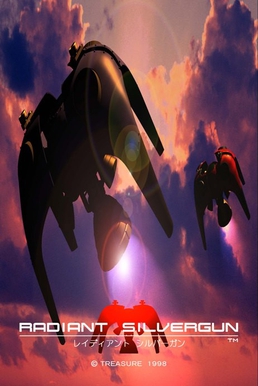
Radiant Silvergun (arcade May 28, 1998; Sega Saturn July 23, 1998, Japan only) is Treasure's vertical shooter directed by Hiroshi Iuchi, with music by Hitoshi Sakimoto. The player ship carries six guns and a sword from the start, and scores by chaining enemies of the same color.
THE MAKING
Ten people, against the marketTreasure had wanted a 2D arcade shooter for years and feared exactly the same thing: Sega kept asking for an arcade game, Maegawa worried the shrinking arcade business was too risky, and director Hiroshi Iuchi worried a 2D shooter had no place among big 3D machines. They made it anyway, because they believed the concept was good. Development began in late 1997 with ten people: three programmers, four artists, one sound designer among them. It was built for Sega's ST-V board precisely because the board was architecturally close to the Saturn, the intended home port.
Iuchi's design rules were refusals. No power-ups, because managing them got him killed in other shooters: all seven weapons are available from the first second, mapped to three buttons and their combinations, including a sword that absorbs pink bullets and charges a screen clearing blast. Bullets were made deliberately slow to welcome a wider audience. Anime studio Gonzo made the Saturn version's animated sequences. And when Maegawa could not finish the game well enough to debug it, Treasure recruited national record holding shooter players to playtest it.
The score is by Hitoshi Sakimoto, whose orchestral writing gives the game its grave, processional weight, a long way from arcade beeps.
Iuchi said he had held the idea for years and pulled no influence from the era's games, except one admitted ancestor: he was a big fan of Irem's Image Fight (1988) and believed some of that inspiration shows. That is a Tier 1, on record influence, stated by the director himself.
THE DESIGN
Chain the colors, level the gunsEvery enemy is red, blue, or yellow. Destroy three of one color in a row and a scoring chain starts; keep chaining the same color and the bonus climbs, touch another color and it breaks. Chaining also levels up the weapon used, permanently for the run, so score play and power are the same act. Bosses are built in segments: strip every appendage before the core and the bonus grows. The story, told out of order in the Saturn mode, is a time loop about a crystal called the Stone-Like, the last four humans, and clones restarting humanity 100,000 years in the past.
THE RELEASE
Japan only, and it did not matterArcade first: May 28, 1998, in Japan only, with Maegawa visiting arcades in person to watch strangers play. Saturn followed on July 23, 1998, also Japan only, selling around 50,000 copies. There was no Western release at all. Western critics imported it anyway and acclaimed it anyway, agreeing it had revived a genre that fighting games had pushed aside. The West waited thirteen years for an official release: Xbox 360 in 2011, in a port that took two and a half years, then Switch in 2022 and Windows in 2023.
THE RECEPTION
The finest technical showcase the Saturn hostedTHE GAME ON THE SHELF
Radiant Silvergun · Arcade and Saturn