
The History of Rival Schools: United by Fate
Rival Schools: United by Fate, known in Japan as Private Justice Academy: Legion of Heroes, is a 1997 3D fighting game produced by Capcom, originally released as an arcade game on Sony ZN-2 hardware. It revolves around tag team battles between students and teachers from rival schools in the fictional Aoharu City, played in a comical, humorous style, with Sakura Kasugano from Street Fighter in the cast.
The PlayStation version of 1998 is the famous one: an expanded two disc release whose second disc, the Evolution disc, carried mini games, extra modes and, in Japan only, a full character creation school simulation. This page covers how it was made, how it was received, and why the series never quite came back.
HOW IT WAS MADE
From Justice Fist to Justice AcademyDirector Hideaki Itsuno wanted to make a 60 frames per second polygon based fighting game. Capcom’s earlier 3D fighter Star Gladiator had been locked to 30fps by effects such as its plasma weapons and backgrounds, and Itsuno believed a real competitive fighter needed 60. The game was originally called Justice Fist, and its story had fighters from every country gathering to decide who was strongest. Itsuno showed the design document to senior co-workers, got a humble response, and rebuilt the concept around something everyone has experienced: school.
In the finished design, two character teams fight one on one, with the partner called in for Team Up attacks that cost two levels of the vigor meter. Tardy Counters, borrowed in spirit from the Alpha Counter, let a blocking player counter attack freely, and Attack Cancels reward two players striking at the same instant. The controls use four buttons, two punches and two kicks, deliberately kept easy to learn. The story follows attacks and kidnappings across Aoharu City’s schools, leading to Justice High, its principal Raizo Imawano, and, if conditions are met, the true final boss, Hyo Imawano. Original artwork is credited to Capcom artist Edayan. At the September 1997 JAMMA show, a 54 percent complete build was the most popular Capcom game on the floor, drawing larger crowds than Street Fighter III: 2nd Impact.
THE RELEASE
Arcade 1997, PlayStation 1998, two discsThe arcade game launched in late 1997, dated November 1997 in North America and December 1997 in Japan, on the PlayStation based ZN-2 board. Game Machine listed it as the most successful arcade game of the month in its February 1, 1998 issue.
The PlayStation port followed on July 30, 1998 in Japan, October 26, 1998 in North America and December 4, 1998 in Europe. The first disc holds the arcade game with animated introduction and ending sequences and voice acted story scenes, plus two fighters the arcade never had as playable characters: Hayato Nekketsu, a hotheaded physical education teacher, and Daigo Kazama, Akira’s elder brother, previously a non playable supporting character. The second disc, the Evolution disc, adds Lesson, Group, League, Tournament and Cooperate modes, sports mini games, and in Japan the Nekketsu Seisyun Nikki mode, a character creation mode in the form of a dating sim that lets a created student live a full school year. That mode was removed from the North American and European versions, a story told in full on its own page in this wing.
THE TWO COVERS
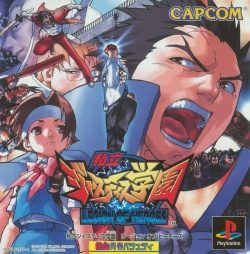
Same game, two shelves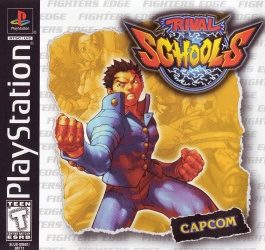
HOW IT WAS RECEIVED
Named scoresWHAT IT LEFT BEHIND
Sequels, cameos, and a long silenceJapan received a PlayStation exclusive expansion in 1999, Private Justice Academy: Nekketsu Seisyun Nikki 2, with two new fighters, Ran Hibiki and Nagare Namikawa, and an expanded school sim. It was never released in the West, and Famitsu scored it 30 out of 40. A true sequel, Project Justice, reached arcades in 2000 and the Dreamcast in 2001 with three character teams. Its character creation board game mode also stayed in Japan.
The cast kept surfacing elsewhere: Kyosuke became playable in Capcom vs. SNK 2 with Batsu and Hinata assisting, Batsu fought in Tatsunoko vs. Capcom, and on August 16, 2021 Akira joined Street Fighter V as its first playable Rival Schools character, with Daigo as her assist. UDON published a Rival Schools comic from 2006, and the band Rival Schools took both its name and its first album title, United by Fate, from the game. Itsuno said for years that he still wanted to make a third game. He left Capcom on August 31, 2024, which makes that sequel far less likely, and leaves the two disc PlayStation original as the series at its fullest.