
The History of Romancing SaGa
Romancing SaGa (Super Famicom, January 28, 1992) is the fourth SaGa game and the series’ leap from the Game Boy to the home console: eight protagonists in the world of Mardias, each with a personal quest feeding one war against the dark god Saruin, explored in whatever order the player chooses under the Free Scenario System. It was created by Akitoshi Kawazu, who directed, designed, and wrote it, with characters by Tomomi Kobayashi and music by Kenji Ito. It sold over a million copies in Japan. The original was never released outside Japan; the West met this game thirteen years later, through its PlayStation 2 remake.
THE BOX
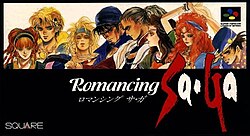
No Western Super Famicom box exists, because there was no Western release of the original. The staged file is 250px wide, below the Library’s working standard, and is a swap-in upgrade when a larger scan is verified.
THE MAKING
Nintendo asked, Kawazu answered, 1990Production began in 1990, when Nintendo, seeing the Game Boy SaGa titles succeed, asked Square to develop a new entry for the in production Super Famicom. Kawazu, pleased to work on stronger hardware, led this team while Square’s new Osaka studio built the third Game Boy game in parallel. He had wanted to break away from the SaGa name entirely; the game kept it, and gained its first word from Nobuyuki Inoue, who suggested Romancing after the adventure film Romancing the Stone. Kawazu was mixed on the impression the title gave, then won over by the illustrations and music that grew to match it.
His design aim was a direct contrast to Final Fantasy: instead of one path, multiple stories experienced at the player’s own pace, which became the Free Scenario System. The eight protagonists drew on taiga dramas and, in their number, on the novel Nanso Satomi Hakkenden; Albert’s scenario was written first. Cartridge size cut planned elements, a limit later versions would restore. Kazuko Shibuya, the Final Fantasy sprite artist, built the sprites from Kobayashi’s designs, and Yoshinori Kitase drew the field maps.
THE ART
Kobayashi’s first gameTomomi Kobayashi had never worked on a game. Kawazu, who had been looking for the right illustrator for some time, contacted her from samples of her work and then gave her unusual freedom: a name and a few elements, and the rest was hers. She designed 40 unique characters, at her peak six a day, including the pirate Hawk, modeled in part on the character Blood from Princess Knight, and her own favorite, the antagonist Saruin. Albert is the cast’s only left handed character, a detail from Kawazu. Her watercolor cast, romantic in the title’s sense, became the series’ visual signature.
THE DESIGN
No experience points, no fixed roadChoose one of eight protagonists, Albert, Aisha, Jamil, Claudia, Hawk, Sif, Gray, or Barbara, and the world opens: events trigger by exploration, conversation, and growing strength rather than by chapter, and the unchosen heroes can be recruited along the way. Battles run in formations on a 3 by 3 grid that governs range and defense. There are no experience points; statistics rise at random according to what a character actually does in battle, and new abilities arrive by using weapons until they are learned. It was, in 1992, a Japanese console RPG built closer to a Western open structure than to its own publisher’s flagship.
THE MUSIC
Ito, rough where Final Fantasy was smoothKenji Ito composed and arranged the score alone, having co-composed Final Fantasy Legend II and helped with Final Fantasy IV’s sound. Kawazu gave no specific instructions but requested rewrites often; most of the score was delivered before the final four months, then rewritten again. Ito deliberately broke from Final Fantasy IV’s fingerstyle emulation, building with sound designer Minoru Akao a slapping, rougher sound with different instruments from Uematsu’s, and finished the game, by his own account, completely burnt out. Two soundtrack albums followed from NTT Publishing.
THE EDITIONS
Japan in 1992, the West in 2005, by remakeTHE RECEPTION
Loved at home, argued over abroadTHE LEGACY
The template the series keptRomancing SaGa popularized its series and fixed its grammar: the Free Scenario structure, the eightfold cast, growth by action rather than experience, all carried into Romancing SaGa 2 in 1993 and Romancing SaGa 3 in 1995, both also Japan only in their era, and into the SaGa games that followed. The West’s thirteen year wait for this one game is the series in miniature: a million selling Japanese institution whose complexity and text volume kept it home, arriving abroad only when a remake could carry it.