
The History of Sakura Wars
Sakura Wars (Sega Saturn, September 27, 1996) fused an adventure game to a tactical RPG and built a franchise that sold more than 5.8 million copies while remaining, for its first fourteen years, entirely Japanese. This page covers the original game: its three year making, the dialogue system that made conversation a timed performance, and the sales record that made it a giant at home and an absence everywhere else.
THE MAKING
Red Company and Sega, 1993 to 1996Creator Oji Hiroi of Red Company, later Red Entertainment, first conceived the game in 1990 and shelved it, before pitching it to Sega vice president Shoichiro Irimajiri as a Saturn project. Development, shared between Sega's CS2 R&D and Red Company, ran three years, double the estimate, and became the most expensive project Sega had undertaken at the time. Skepticism inside both companies was real; Hiroi promised at least 200,000 units. Character design is by Kōsuke Fujishima, the scenario by Satoru Akahori, and the music, threaded with songs the cast performs, by Kohei Tanaka.
The promise was kept in a week. The game sold out in many stores within hours, moved 205,270 copies in its opening week (roughly 57 percent of the launch shipment, per Famitsu), the largest debut Sega had recorded, and finished at 359,485 copies on the Saturn, the biggest selling original title on the system. It won the 1997 CESA Grand Prix and the Game of the Year Semi Grand Prix, and stood second only to Final Fantasy VII on Famitsu's 1996 most wanted list.
THE DESIGN
A genre Sega had to nameSega marketed the game as a "dramatic adventure," a label invented because no shelf category fit: adventure segments in a fictionalized Taishō era Tokyo of 1923, where the Flower Division defends the capital in steam powered Koubu armor while posing undercover as a theater troupe, alternate with grid based tactical battles. The blend of narrative and tactics took Fire Emblem as its reference point, as the franchise record states.
The signature system is LIPS, the Live & Interactive Picture System: dialogue choices on a timer, where hesitation is itself an answer and trust earned in conversation feeds performance in battle. The recorded rationale is practical and elegant: the staff disliked dialogue that froze time, and timed choices keep the story moving at the speed of speech. It is the mechanic the whole franchise, and a generation of later adventure games, inherited.
THE EDITIONS
One Saturn cover, and it is Japanese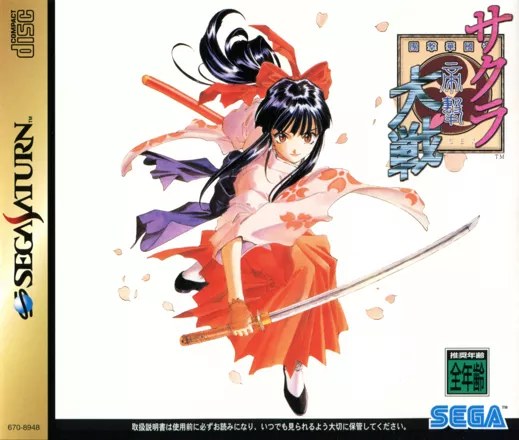
THE RECEPTION
Famitsu 33, and a phenomenon around the scoreInside Japan the reception can be measured in the franchise's own momentum: a sequel outselling the original, stage productions, anime, and a series total past three million by early 2002 and 4.5 million by 2010. The honest dissent on the record is structural rather than scored: the hybrid that made it unclassifiable also made it, for decades, unexportable in the eyes of the industry that owned it.
THE LEGACY
The giant, documentedSakura Wars became one of Sega's defining Japanese franchises and one of the great what ifs of Western Saturn collecting: a system seller that sold a system in only one country. Its systems thinking, conversation as gameplay, spread across the adventure genre. And its original edition remains exactly what it was in 1996, a Japanese Saturn disc, common in its homeland and eloquent abroad: proof that a game can be a giant and a ghost at the same time, depending on which side of the Pacific you stand on.