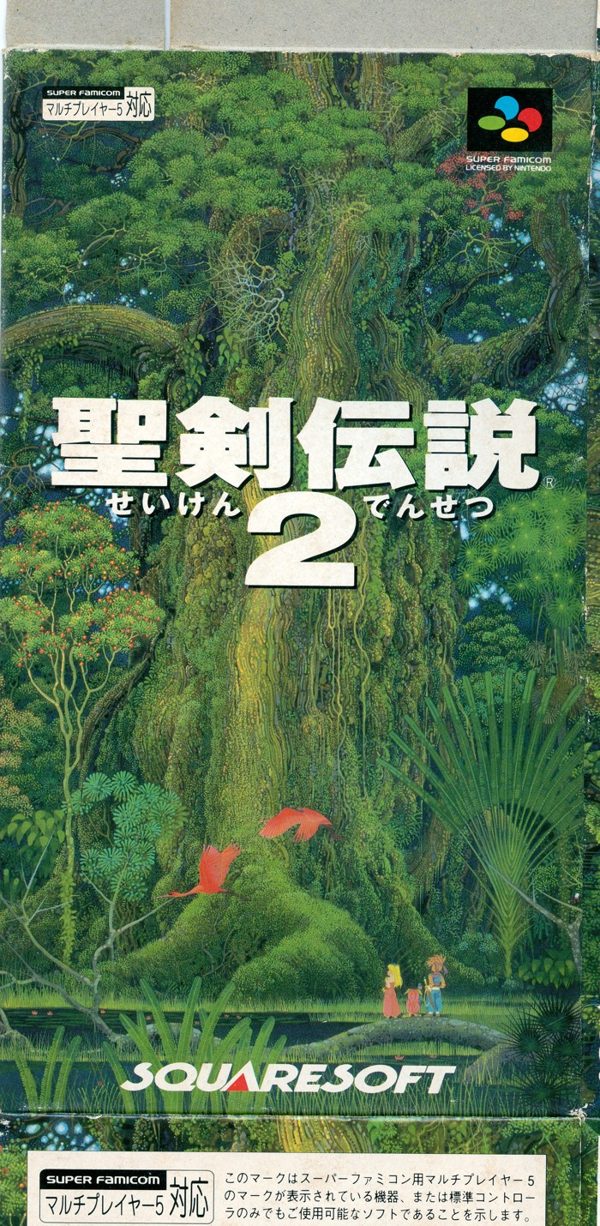
The History of Secret of Mana
Secret of Mana, released in Japan as Seiken Densetsu 2 (Super Famicom, August 6, 1993; Super NES, October 1993), is Square's real-time answer to the turn-based era: three heroes, one Mana Sword, and battles that never stop moving. It sold out its first Japanese shipment within days, sold 1.003 million copies in Japan in 1993, second only to Street Fighter II Turbo that year, and shipped 1.83 million worldwide by 2003.
THE MAKING
The game the CD-ROM add-on took with itDirector and designer Koichi Ishii, creator of the Game Boy predecessor Final Fantasy Adventure, has said Mana feels more his game than anything else he worked on. Producer and writer Hiromichi Tanaka and programmer Nasir Gebelli led the build, and newcomer Hiroki Kikuta composed his first game score, working near 24-hour days and building his own instrument samples so he would know exactly how every piece sounded on the hardware.
The project had two earlier lives. Tanaka has said it was originally intended to be Final Fantasy IV, then developed under the codename Chrono Trigger, before becoming Seiken Densetsu 2. More consequentially, it was planned as a launch title for the SNES-CD add-on. When the Nintendo and Sony contract collapsed and Sony's work became the PlayStation, Square rebuilt the game for cartridge. Ishii estimated up to forty percent of the planned game was cut: the branching routes, the multiple endings, and a much darker story all went.
THE DESIGN
Real time, in a ringBattles run in real time around a power gauge: swing and the gauge empties, wait and the next blow lands at full strength. Menus open as Ring Commands, circles of icons hovering over the hero that pause the action without leaving it. The experience and leveling systems came from Final Fantasy III, by the creators' own account, while battle mechanics first considered for Final Fantasy IV found their home here, and several ideas Mana left unused were picked up by the Chrono Trigger team working alongside it.
The multiplayer was an accident kept on purpose. It was not in the original design; the developers realized all three characters could simply be handed to human players, and shipped drop-in, drop-out cooperative play for up to three players through the Super Multitap. In 1993, an RPG you could play with two friends on one couch was close to unheard of.
THE EDITIONS
Thirty days to translateTHE RECEPTION
The magazines competed to praise itThe dissent is mostly about finish, then and now. Nintendo Power praised the graphics and depth while criticizing the unnecessarily long sword power-up and the awkward item selection, and critics have long suspected the CD-to-cartridge collapse left technical roughness when the screen fills. None of it dented the standing: Next Generation reported more than 500,000 copies sold in the United States alone by 1996, remarkable for an unhyped RPG, and called it a game many players considered the RPG equivalent of The Lord of the Rings.
THE LEGACY
The formative ManaSecret of Mana made its series: it was the first Seiken Densetsu marketed under the Mana name rather than as a Final Fantasy side story, and retrospectives treat it as the formative entry, the one that set the series' real-time, cooperative identity. Retrospective scores held up, 9 of 10 from IGN and Eurogamer for the Virtual Console edition, and it is a standard entry on greatest games lists.
Its music escaped the cartridge, too: a rendition of Kikuta's score was commissioned for the first BBC Proms gaming concert in 2022. And its lost CD-ROM self remains one of gaming's great what-ifs, a bigger, darker, branching Mana that exists only in its creators' interviews. This Library documents what shipped: the forest on the box, painted by Hiroo Isono, is the game the world actually got.
THE GAME ON THE SHELF
Secret of Mana · Super Famicom