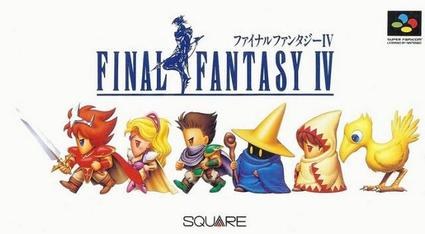
The History of Final Fantasy IV
The first Final Fantasy built for 16-bit hardware, Final Fantasy IV (Super Famicom, July 19, 1991) follows Cecil Harvey, a dark knight of Baron who steals crystals on his king's orders, questions them, and spends the game earning his way back. It reached North America four months later under a different number, as Final Fantasy II, because the real II and III had never left Japan. The Super Famicom version sold 1.44 million copies in Japan, and the game's many versions have sold more than four million worldwide.
THE MAKING
Square, 1991Development sat with series creator Hironobu Sakaguchi as director, Takashi Tokita as designer and lead writer (Sakaguchi shared the writing credit), Yoshitaka Amano on art, and Nobuo Uematsu composing. It was the series' first game designed for the Super Famicom's hardware rather than the Famicom's, and the team used the new machine openly: Mode 7 scaling and tilting made the airship flights feel like flight.
The cast was the experiment. Earlier games let players build a party of blank heroes; IV fixed every character's class in advance, a summoner stays a summoner, and let the story, not the player, decide who stands in the party and when. Twelve playable characters rotate through a party that, for the first time in the series, holds five at once.
THE DESIGN
Active Time Battle, and characters who leaveIV introduced Square's Active Time Battle system: enemies no longer wait politely for orders, so battles run in real time while the player thinks. ATB carried into five subsequent Final Fantasy games and became the series' signature for a decade.
The design serves the drama. Characters join, leave, sacrifice themselves, and in Kain's case betray the party under mind control, because their motives belong to the plot rather than to party management. Dragon's reviewer Sandy Petersen singled exactly this out in 1993: the party does not simply stick together, and the effect, he wrote, is like following the storyline of a fantasy novel. Cecil's own arc is the template: the dark knight climbs Mount Ordeals and comes down a paladin, his old self literally fought and abandoned.
THE EDITIONS
One game, two numbersTHE RECEPTION
Acclaim, with the dissent keptThe dissent is on record too. Petersen, praising the story, still called the graphics inferior to Zelda's and the combat stylized, and retrospective reviewers have repeatedly criticized the original English translation's cuts and simplifications. Both things survived: the reputation, and the argument about the translation.
THE LEGACY
The dramatic templateRetrospectives credit IV with pioneering features now treated as console RPG basics, dramatic storytelling first among them. Its systems had a long half-life: ATB defined the next five mainline games, and its fixed-class, story-driven party became the model VI would loosen and VII would inherit.
Square has never let it rest. Beyond the remakes, the game anchors The Complete Collection, joined the Pixel Remaster line in 2021, and continues to be the reference point for what a 16-bit RPG plot can carry: guilt, betrayal, redemption, and a trip to the moon.
THE GAME ON THE SHELF
Final Fantasy IV · Super Famicom