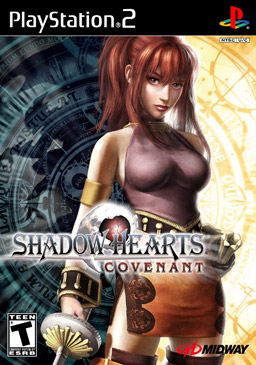
The History of Shadow Hearts: Covenant
Shadow Hearts: Covenant (PlayStation 2, 2004), titled Shadow Hearts II in Japan, is the second game in Sacnoth's alternate history series and the first the studio released under its new name, Nautilus. It opens in 1915, six months after the first game and on the road its bad ending laid down: Alice Elliot is dead, Yuri Hyuga is defending a French village from the war, and a German lieutenant named Karin Koenig has been sent to catch a demon who turns out to be him.
THE MAKING
Sacnoth becomes Nautilus, and listens to its playersDevelopment began in the autumn of 2002. Returning staff included writer and director Matsuzo Machida, character designer Miyako Kato, and composer Yoshitaka Hirota, joined on music by Yasunori Mitsuda, Kenji Ito, and Tomoko Kobayashi. During production Sacnoth rebranded as Nautilus; Covenant was the company's first title released under the new branding.
Two kinds of player feedback shaped the sequel on the record. Players of the first game found its tone too dark and disturbing, so the staff kept the serious atmosphere and deliberately built in comic relief. The first game's battle mechanics had drawn criticism, so the combat system was revamped, a redesign designer Takehiro Ishida described as a challenge aimed at a greater sense of speed and action. Machida set the theme as happiness, the many ways people find it, worked out mainly through Yuri. The production's scale crept: Machida storyboarded the cutscenes himself, planning two and a half hours of them and finishing with over four, and real actors performed motion capture for the whole cast except Blanca the wolf, who was played for comic relief.
Even the ending's biggest turn was a late decision. Machida has said the revelation about Karin was not settled until he was writing the ending; a conventional romance for Yuri and Karin would, in his judgment, have worked against the pure love theme around Yuri and Alice, and left Yuri no reason to try to change the past.
THE DESIGN
The ring, the Graveyard, and 1915Every action in battle, attacks, spells, items, even shopping discounts, runs through the Judgment Ring: a disc with colored hit areas and a sweeping pointer, where the thin red edge of a zone boosts the action and a miss can shorten or cancel it. Covenant rebuilds the ring with multiple ring types, customization that trades hit area size against power, and an auto option, then layers a combo system on top: chain characters' actions with successful ring hits and each hit raises the next character's damage, with a four character combo triggering a fifth, magical strike.
Yuri and, late in the game, Kurando fight by Fusion, transforming into monsters unlocked in the Graveyard, the realm inside Yuri's soul, by charging gravestones with Soul energy from defeated enemies. Sanity Points drain every turn, and a character who runs out goes berserk and leaves the player's control. Around the systems sits the setting that made the series: real 1915, the Great War, Rasputin and the Romanovs, a fictionalized Anastasia, and Lovecraftian horror underneath the history. The monsters, as on the first game, drew on H. P. Lovecraft's Cthulhu Mythos.
THE EDITIONS
A limited edition, a Western name, and a Japan only cutTHE RECEPTION
IGN's PS2 RPG of the yearTHE LEGACY
A success its studio did not outliveCovenant sold around 240,000 units across Japan and North America, with Japanese sales near 150,000 by November 2004. Aruze counted it a success and credited it in a profitable period for its games division; Midway likewise credited it among the titles behind a rise in revenues. For a sequel to a game Aruze had called a low seller at roughly 110,000 copies, that was the series finding its audience.
A third game, Shadow Hearts: From the New World, followed in 2005, but Machida's planned continuation of Yuri's own story never materialized, and Nautilus was absorbed into Aruze in 2007 and ceased making console games. The reputation outlasted the studio: IGN, GamesRadar, Game Informer, and Polygon have all since ranked Covenant among the best RPGs or best games of all time, and GameTrailers called it the greatest JRPG that no one talks about.
THE GAME ON THE SHELF
Covenant · PS2