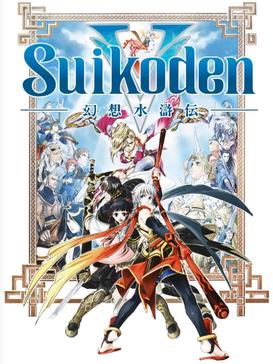
The History of Suikoden V
Suikoden V (PlayStation 2, 2006), Gensou Suikoden V in Japan, is the fifth and final main installment of Konami's series, developed by Konami with Hudson Soft. After two PlayStation 2 entries that had rearranged the series' foundations, V deliberately rebuilt them: six person parties, the 108 Stars of Destiny, a headquarters, real time war battles, and a political story set in the Queendom of Falena six years before the first Suikoden. It is loosely based, as the series is, on the classical Chinese novel Shui Hu Zhuan.
THE MAKING
A cancelled side game, and a scenario drafted overnightSuikoden V was directed by Takahiro Sakiyama, a newcomer to the series, and written by Kazuyoshi Tsugawa. Development began while Sakiyama was working at concept stage on a Suikoden side game; producer Noritada Matsukawa asked whether he was interested in directing Suikoden V instead. The side project was cancelled, Sakiyama took the main game, and, by his own account on Konami's blog, he drafted the framework of the scenario the next day.
The music was composed by a Hudson Soft team under Konami veteran Norikazu Miura's direction, and the production reached for scale in its opening theme, Wind of Phantom, composed by Yuji Toriyama, conducted by Robin Smith, and performed by the Royal Philharmonic Orchestra. The complete original soundtrack followed on March 24, 2006.
THE DESIGN
Six in the party, 108 in the castleThe headline reversal is the party: six characters in combat, against Suikoden IV's four, each individually controllable, arranged in formations across a grid that trade statistics against each other and carry their own formation attacks. The skill system returns in the shape Suikoden III built, two skills equipped per character and swappable between battles, and the camera returns to a top down style perspective in the manner of the first two games, a first for a 3D Suikoden, running at 60 frames per second.
The war battles run in real time on a continuous field, land and naval and sometimes both at once, on a rock paper scissors logic of cavalry, infantry, and archers, with rune magic and leadership bonuses bending it. And above the systems sits the series' signature structure: 108 Stars of Destiny to recruit, over sixty of them usable in combat, the rest running shops, offering clues, or crewing the war effort, with some missable entirely if their moment passes. The endings grade the gathering directly, up to the full company of 108.
Falena itself is the design's other half: a queendom where the first born daughter inherits, ruled by Queen Arshtat, whose bearing of the Sun Rune, one of the 27 True Runes, has made her erratic since she used it to scorch the rebellious town of Lordlake. The Sacred Games for her daughter Lymsleia's hand becomes the trigger for a coup, a civil war between the Godwin and Barows houses, and the Prince's long march home.
THE EDITIONS
One worldwide shape, in one seasonTHE RECEPTION
The story won the awardsTHE LEGACY
194,780 copies, and the end of the lineSuikoden V sold 194,780 copies in Japan in 2006, around 200,000 in total there, down from Suikoden IV's 303,069, sales the record calls disappointing against its predecessors. The return to form was critical and fan facing, not commercial: 1UP called it a welcome return to form for the series, and the loading screens themselves nod at the apology, showing the cast as 32 bit sprites in the style of the games V was returning to.
No sixth main Suikoden followed on consoles. V remains the last classic Suikoden, the one that put the series back together, six in the party, 108 in the castle, politics before prophecy, one print run too late in the PlayStation 2's life to restart what it had repaired.
THE GAME ON THE SHELF
Suikoden V · PS2