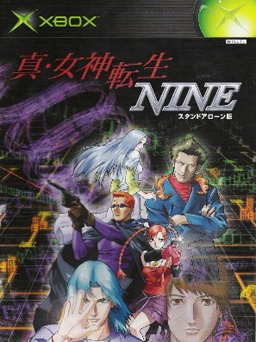
The History of Shin Megami Tensei: Nine
Shin Megami Tensei: Nine (Xbox, Japan, December 5, 2002) is the strangest object on this shelf: a mainline entry in Atlus's flagship series, built exclusively for an American console that was failing in Japan, released only in Japan, and never officially released, translated, or reissued anywhere else since. Its name is not a number count. It refers to the game's nine moral alignments, and nearly everything about the game, its online ambitions, its split release, and its afterlife, follows from decisions documented at the time.
THE MAKING
An online Shin Megami Tensei, planned in 2001The concept originated in staff discussions about how Shin Megami Tensei would work as an online game. Development began in 2001 at Atlus's R and D 1 with help from NexTech, produced by series veteran Kouji Okada, directed by Kazunori Sakai, and written by Nobutaka Shimizu. The game was announced on August 27, 2001 at the Xbox Conference Summer 2001 under the title Shin Megami Tensei Online, and renamed Nine in February 2002, in part so players would not worry the game was exclusively online; the single player campaign was conceived as an introduction to the online component.
Established staff carried the series' identity: Kazuma Kaneko designed new demons, and, finding goddess figures such as Maria a new challenge, suggested bringing in a collaborator, so Yasuomi Umetsu designed the main characters. The technical ambitions were firsts for the series: the first Megami Tensei on an Xbox console, the first with fully 3D graphics, the first to shift from first person to a third person camera, the first customizable avatar, and early use of 5.1 surround sound. Sound director Takahiro Ogata and composer Masaki Kurokawa recorded ambient sound in Tokyo districts including Kichijoji and Roppongi to build the game's virtual city, and estimated over three hundred possible variants of the battle music, which shifted with the player's alignment. Okada described the development, on the record, as challenging, with the new real time battle system and the second, tactical hacking system the hardest parts to balance.
THE DESIGN
Idea Space, a virtual Tokyo between two apocalypsesNine is set between Shin Megami Tensei and its sequel: after the ICBM strike on Tokyo, survivors live underground and spend their lives in Idea Space, a virtual recreation of 1990s Tokyo built from districts including Shinjuku, Shibuya, and Ikebukuro. The player, default name Kei Azuma, is recruited as a Debugger, hunting the Noise, digitized demons attacking the system. Demon negotiation and fusion return, attitudes shifting with the moon phase, and summoning capacity is measured in “kilodevil” values that can be compressed in the Cathedral of Shadows.
The title system is the nine alignments: the series' Law, Neutral, and Chaos axis crossed with a Light, Neutral, and Dark axis, tracked on a three by three matrix. Okada's stated reason was to explore the original game's moral alignments in more detail, which is also why the game sits between the first two entries. Battles reward no experience points; equipped jewels set the protagonist's strengths, one of several experiments that make Nine the series' most mechanically unusual mainline entry.
THE EDITIONS
The versions that existTHE RECEPTION
The scores, with the dissent keptTHE LEGACY
The only Shin Megami Tensei made for a Microsoft consoleNine remains, in the documented record, the only title in the entire Megami Tensei franchise made exclusively for a Microsoft console, and it was the only Shin Megami Tensei on any Xbox until Shin Megami Tensei V: Vengeance reached Xbox One and Series X/S in 2024, twenty two years later. Its online half survived by changing platforms and names, becoming Imagine. Its single player half became a fixed point for collectors: a mainline Atlus RPG, in a green Xbox case, in Japanese only, on a console Japan largely declined to buy.
For this Library's purposes Nine is the textbook Japan gap: a series with proven and growing Western demand, a mainline entry the West was never offered in any form, and physical copies that exist only as Japanese prints. The demand side of that gap is documented by the series' Western history since; the supply side is a single 2002 print run and one budget reissue, both Japan only.
THE GAME ON THE SHELF
SMT Nine · Xbox