
The History of Shining Force III
Shining Force III (Sega Saturn, 1997 to 1998) is not one game in Japan. It is three full games, three discs sold months apart, each following a different army through the same war, with save data carried forward between them. The Western release, titled simply Shining Force III, is Scenario 1 only. Everything on this page keeps that structure exact, because the structure is the story of the game.
THE MAKING
Camelot, 1996 to 1998Work began at Sonic! Software Planning, by then becoming Camelot Software Planning, while the team was still finishing Shining the Holy Ark in 1996. Director Yasuhiro Taguchi led a staff of more than thirty; Hiroyuki Takahashi produced, wrote, and designed, with Shugo Takahashi, and Motoi Sakuraba composed. The project took nearly two years and was announced in August 1997. The ambition was the format itself: one war, three protagonists, three retail releases whose saved games would speak to each other.
THE THREE SCENARIOS
The structure, stated preciselyScenario 1, subtitled in Japan Giant God of the Royal Capital, follows Synbios of the Republic of Aspinia. It released in Japan on December 11, 1997, in Europe on June 12, 1998, and in North America on July 31, 1998. Scenario 2, Target: Child of God, follows Prince Medion of the Empire of Destonia, the opposing power; its events run parallel to Scenario 1 and interlock with it, the same battles and betrayals seen from the other side of the field. It released in Japan on April 29, 1998, and nowhere else. Scenario 3, Bulzome Rising, follows Julian, a mercenary who appears in both earlier scenarios and is, in the developers' framing, the true main character; it begins near the three quarter mark of the shared timeline and delivers the ending, against the priest Bulzome. Japan only, September 23, 1998.
The connective tissue is the Synchronicity system: a completed save from each scenario imports into the next, carrying choices and outcomes forward to influence events and rewards. A fourth disc, the Premium Disk, was mailed to Japanese players who submitted proof of purchase for all three scenarios, carrying concept art, a model viewer, and bonus battles fought with imported data. The Western script of Scenario 1 was given minor edits to resolve an ending that, in Japan, is a cliffhanger into a game the West never received.
THE DESIGN
The grid, kept and modernizedThe battles are the series' grid tactics, presented in 3D: polygonal battlefields with a rotating camera, 2D sprite characters in the exploration towns. Defeat carries the series' signature mercy, no game over screen; a fallen force loses half its money and keeps its experience. Allies who fight adjacent build friendship, earning stat bonuses, and weapons carry triangle style strengths and weaknesses. Characters promote between levels 10 and 20. It is a conservative design by the standards of 1997, and that conservatism is exactly what its defenders and its critics both wrote about.
THE EDITIONS
What each region actually holdsScenario 1, both sides of the Pacific
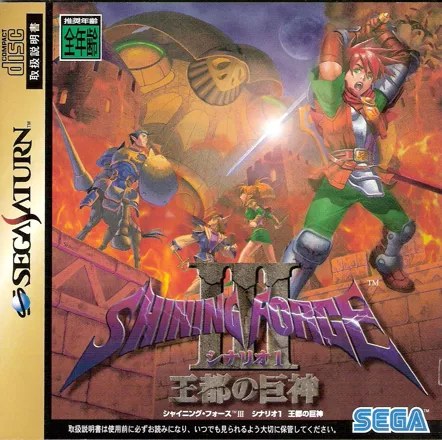
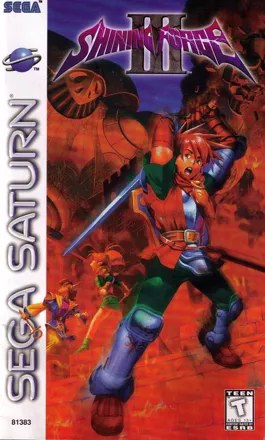
The Japanese Scenario 1 retailed at ¥4,800 (about $36 at the era's rate). The European release is documented by Shining Force Central as "Very Rare," the Western print shaped by the same late Saturn wind down that defines this whole shelf.
THE RECEPTION
Praise, and the unfinished sentenceRPGFan's two reviews, 83 and 92 percent, bracket the argument. The dissent came from Next Generation, whose import review charged that keeping the old gameplay format and interface was a failure to move the series forward, before conceding it was "a worthy upgrade"; its American review landed on "underproduced, underrated, but fun as hell." Both halves of that sentence have aged well. The game was underproduced for the West in the most literal way: two thirds of it was never produced there at all.
THE LEGACY
Finished by its fansSega's Charles Bellfield floated a PlayStation port in 2001; it never happened, and no scenario of Shining Force III has ever been officially rereleased. The completion, when it came, was fan made: translation projects have rendered Scenarios 2 and 3 playable in English, the strongest demand evidence a game can produce, its audience doing the publisher's unfinished work. For collectors the shape is the signal: the Western Scenario 1 is a first volume wearing a complete game's title, and the full work exists, physically, only in Japanese.