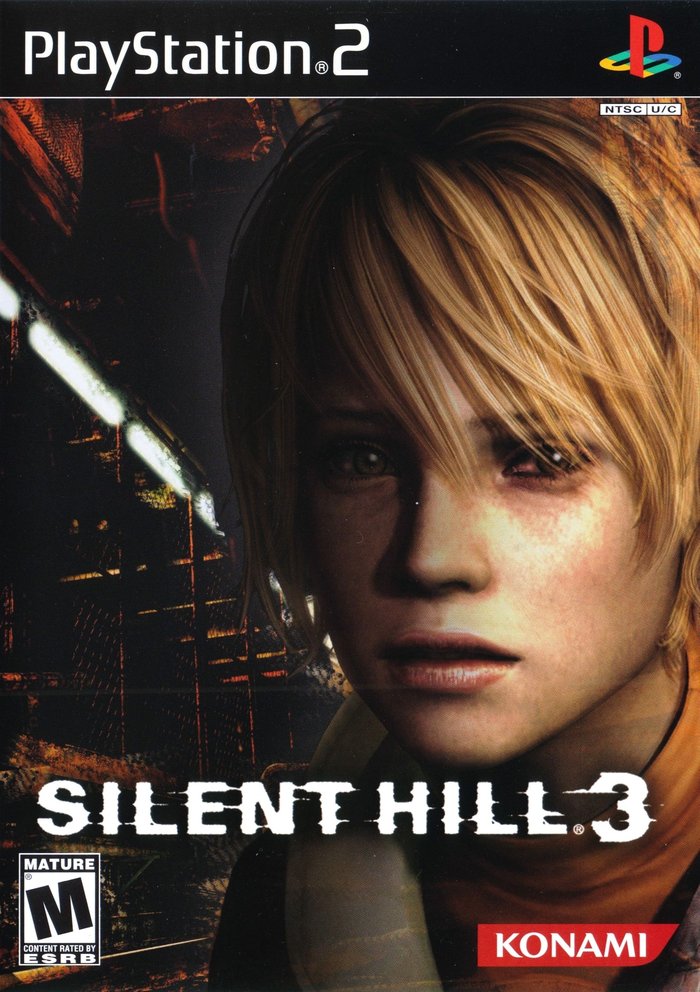
The History of Silent Hill 3
Seventeen years after Harry Mason carried a baby out of Silent Hill, the baby is a teenager named Heather, and the cult wants her back. Silent Hill 3 (PlayStation 2, 2003) is the series' direct sequel to its first game: Heather learns she is Alessa Gillespie reincarnated, and that the priestess Claudia Wolf intends her to birth the cult's god. It sold over 300,000 copies in its first months and topped the Japanese chart on release.
THE MAKING
Team Silent, 2001 to 2003Development began after Silent Hill 2 shipped in September 2001, with a smaller team of around forty people: the core of the second game's staff plus newcomers. Kazuhide Nakazawa directed, Hiroyuki Owaku wrote, Masahiro Ito led the art, and Akira Yamaoka stepped up to produce as well as compose. The game was built at the same time as Silent Hill 4: The Room, by the same studio, in parallel.
It nearly was not this game at all. Because Silent Hill 2's early sales in Japan were slow, Silent Hill 3 was originally planned as a rail shooter spin-off. The plan wasted considerable time and budget before it was discarded and the early work almost completely scrapped; the rail shooter idea later surfaced as the 2007 arcade game. By Ito's account the final game was then built from scratch in ten months, with Owaku writing the scenario in one month. Ito also added the figure of Valtiel, who was not in Owaku's scenario, because he felt the script needed him.
THE DESIGN
Faces from film, a voice in the musicThe developers cited the film Jacob's Ladder and the novels of Stephen King among the game's influences; one subway platform is named Bergen Street Station after the station Jacob asks about in the film. Character design, documented in Konami's Book of Lost Memories, worked from real performers: Claudia was modeled on Julianne Moore and then had her eyebrows removed so the face read slightly wrong; detective Douglas Cartland took his name from Douglas Fairbanks and his sketches from Giancarlo Giannini and Ian Holm; Vincent's name and unshaven look came from Vincent Gallo.
Yamaoka's soundtrack was a first for the series: the first to use vocals prominently, most of them sung by Mary Elizabeth McGlynn. The lead song, "You're Not Here," traveled further than the game, into the PlayStation 2 port of Dance Dance Revolution Extreme. In North America the soundtrack album was included with the game itself, a pack-in American buyers of the later games would not get again.
THE EDITIONS
One game, a shelf of versionsTHE RECEPTION
Acclaim, with the dissent keptReviewers praised the horror and the atmosphere, calling it a "satisfying, coherent sequel," and credited the graphics, audio, and production values with carrying the dread. The complaints were consistent: it innovated little, the camera and controls were still called awkward and disorienting, and it could be finished in a handful of hours. Commercially it opened strong in Japan, selling 58,000 copies in three days to top the chart, and passed 300,000 copies worldwide by September 30, 2003.
THE LEGACY
The Alessa arc, closedSilent Hill 3 is the payoff the 1999 game planted: the only numbered sequel that answers the first game's story instead of starting a new one, and the game that gives the series a protagonist who talks back. Heather's sarcasm in the face of the cult is the tonal opposite of her father's silence, and it is her game that the film series chose to adapt second.
It also marks the moment the series' sound became a voice. The vocal soundtrack format Yamaoka and McGlynn established here carried into Silent Hill 4 and became the series' public signature, the songs as recognizable as the fog.
THE GAME ON THE SHELF
Silent Hill 3 · PS2