The History of Sin and Punishment
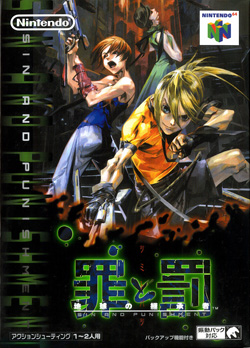
Sin and Punishment (Nintendo 64, November 21, 2000, Japan only) is the rail shooter co-developed by Treasure and Nintendo, directed by Hideyuki Suganami with art by Yasushi Suzuki. Saki and Airan fight across a famine struck future Japan of 2007, on rails, under the player's reticle.
THE MAKING
Built around the controller's forgotten gripCo-developed by Treasure and Nintendo R&D1 from a 1997 proposal, Sin and Punishment exists because of a controller. Nintendo had suggested two ways to hold the Nintendo 64 pad; Super Mario 64 made the right hand grip the standard, and Treasure president Maegawa asked what a game built for the left position would look like. Nintendo worried it would feel unnatural. Treasure expected that, and built it anyway: move with one hand cluster, aim the reticle with the stick.
It was Treasure's first true 3D action game, and the record is candid about the cost: the Nintendo 64's professional Silicon Graphics architecture was hard, the reticle moved in 2D inside a 3D world, collision had to feel right, and designer Yasushi Suzuki cut joints from models to hold the frame rate. Staffing started at what Maegawa called the absolute minimum, two programmers and two designers, and ended with more people than any previous Treasure project. Nintendo's Hitoshi Yamagami called Treasure a weird company that deflected deadlines; when he found a prototype too hard, Treasure told him he should not supervise a game he could not play. The difficulty argument ran almost a year before Treasure lowered it.
Composer Toshiya Yamanaka wrote the score on a Roland SC-88 Pro, and a programmer's PCM support let the cartridge play higher quality digital audio than the hardware usually managed.
Even the title was negotiated. For most of development the game was Glass Soldier, for its fragile hero. Yamagami wanted a kanji title to stand out among katakana names, took a cue from Perfect Dark's Japanese kanji title, and proposed Tsumi to Batsu, the exact Japanese title of Dostoevsky's Crime and Punishment. Treasure disliked the change at first, then came around.
THE DESIGN
Run forward, aim everywhereA rail shooter from behind the back: the character advances automatically while the player strafes, double jumps, rolls, and shoots with a reticle that can free aim for power or lock on for speed. A sword handles close enemies and knocks projectiles back at their senders. Two players can split the work, one moving, one firing. Its low polygon models were a deliberate trade: critics at the time and since have noted the team spent the hardware budget on smooth, crowded action instead of detailed figures.
THE RELEASE
Japan 2000, the West 2007Japan only, November 21, 2000, near the end of the Nintendo 64's life, aimed at older players, selling about 100,000 copies. Maegawa said he could not call it a financial success, but Nintendo had wanted the genre represented on the machine. The voice acting was already in English, which made the game an import favorite and, later, the most demanded kind of Virtual Console candidate. The West finally got it on the Wii Virtual Console in 2007 (Japan September 20, PAL September 28, North America October 1), then Wii U in 2015 and 2016, and the Nintendo Classics service in 2021. A Wii sequel, Sin and Punishment: Star Successor, followed in 2009.
THE RECEPTION
A masterpiece the West never got, until it didTHE GAME ON THE SHELF
Sin and Punishment · Nintendo 64