The History of Sonic the Hedgehog
Sonic the Hedgehog launched for the Genesis and Mega Drive in June 1991, North America first on June 23 and Japan on July 26, and it did the job it was commissioned for: bundled with the Genesis, it sold over 15 million copies on that system alone, the best selling Genesis game ever, and made Sega a direct rival to Nintendo for the first time.
This page is the making of that game. The mandate behind it has its own page in this Library, linked below, and so does the question of what inspired Sonic's look.
THE MAKING
Sega, April 1990 to June 1991Development began in April 1990, after Sega ordered a game built around a new company mascot. An internal design contest produced the candidates, and artist Naoto Ohshima's hedgehog won. The team that formed around him was small, seven people at its core, and it named itself Sonic Team after its character: Ohshima designing the character, programmer Yuji Naka building the engine, and Hirokazu Yasuhara designing the game and its levels.
The technical heart came from Naka. His prototype was a fast character rolling in a ball through a long winding tube, moved smoothly along curves by an algorithm using a dot matrix to fix its position. That rolling ball is why the hero had to be an animal that could curl up and do damage with its covering, and it is why the levels are full of loops, corkscrews and half pipes: Yasuhara built a world shaped for the ball. Naka, an admirer of Shigeru Miyamoto's design simplicity, kept the controls to a directional pad and one button, and made the game more action focused than the Mario games it was aimed at.
The music was an outside commission with a famous name attached. Sega hired Masato Nakamura, bassist and songwriter of the J-pop band Dreams Come True, who had only just debuted with the band. Nakamura worked from screenshots and descriptions of the stages, treated the game as a film he was scoring, and wrote the Green Hill Zone theme first, then the title theme, all while recording a Dreams Come True album in the same period. The hardware allowed only four sounds at once, a limit he has discussed on record; the melodies survived it and became the sound of the series.
THE DESIGN
Six zones, six emeralds, one buttonSonic runs through six zones of three acts each, from the checkerboard hills of Green Hill to the machinery of Scrap Brain, hunting six Chaos Emeralds in rotating special stages and freeing the animals Dr. Eggman has sealed inside his robots. The economy is the series template from day one: rings are health, one hundred rings are a life, and speed is always available and always dangerous.
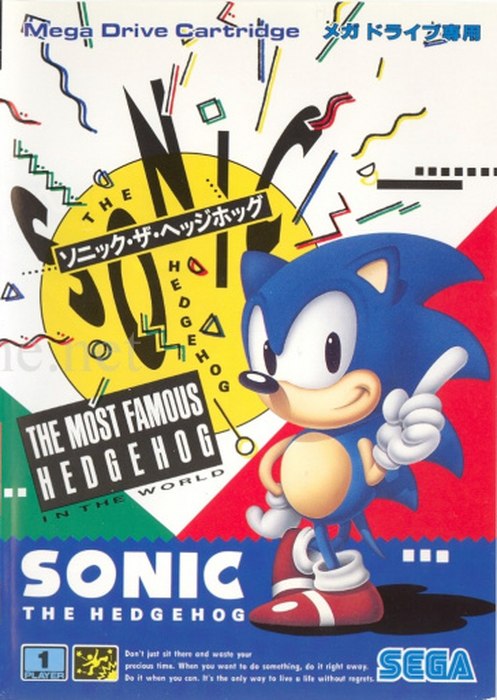
The regional split that this Library documents elsewhere began here. The game under both boxes is the same; the Sonic drawn on the Japanese box and the Sonic drawn on the American box are not, and the villain answers to Eggman in one manual and Robotnik in the other. Those two stories have their own pages, linked from the gallery.
THE EDITIONS
One cartridge, then everywhereTHE RECEPTION
Acclaim, with the dissent keptThe dissent of the era was mostly aimed at the idea rather than the execution: a platform game built on speed was accused of playing itself, of asking the player to hold right and watch. The retrospective verdict settled the argument the other way, and the game is now routinely counted among the greatest ever made.
THE LEGACY
The console war starts hereSonic's success let Sega compete directly with Nintendo through the 16 bit era, in the rivalry the period itself named the console wars. Almost everything on this shelf descends from this cartridge: the sidekick, the sequel built in America, the CD experiment, the split sequel of 1994, and the 3D reinvention that closed the decade.