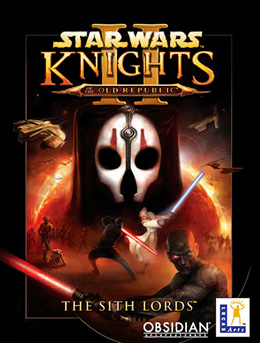
The History of Star Wars: Knights of the Old Republic II
Star Wars Knights of the Old Republic II: The Sith Lords (Xbox, 2004) is two stories at once. On the disc, it is Obsidian Entertainment's first game, a darker and more philosophical sequel built around a Jedi Exile and a mentor, Kreia, who questions the Force itself. Behind the disc, it is the most documented case of its era of a game shipped before it was finished, by the studio's own later account. Both stories are on this page, and the second has its own question page in this Library, linked below.
THE MAKING
BioWare recommends Obsidian, and declines the scheduleBioWare suggested that Obsidian, a new studio founded by veterans of Black Isle Studios, be offered the license: the two teams knew each other's work, and BioWare found LucasArts' development schedule for the sequel too tight. The schedule in question, as lead designer Chris Avellone and co-founder Feargus Urquhart have both stated on the record, ran about 14 to 16 months. Development began in October 2003, before the original game had finished selling its first wave, and initial story work had started even earlier, then saw major redrafts once the team could study the finished first game.
Avellone prepared by immersing himself in the expanded universe, books, guides, modules, and graphic novels, and has said Obsidian recognized that the story and companions made the first game great, and tried to expand on both. The game runs on the same Odyssey Engine as its predecessor, with music by Mark Griskey. Urquhart's account of the final schedule change is the famous one: the game was planned for 2005, then moved up to December 2004 after E3, and the studio chose, in his words, between getting in trouble and getting it done. The full documented record of the cuts is on the question page.
THE DESIGN
Influence, prestige classes, and a wound in the ForceThe Exile is a Jedi who served under Revan in the Mandalorian Wars and ordered the activation of the Mass Shadow Generator at Malachor V, a cataclysm that severed the Exile's own connection to the Force. The sequel's systems build on that premise: companions can be influenced, drawn toward the light or dark side by the player's example, and some can be trained in the ways of the Force. Thirty new Force powers, new lightsaber forms, and prestige classes deepen the original's build craft.
The writing is the design's center. Kreia, the Exile's mentor, treats the Force not as a faith but as a suspect, and the game's three Sith Lords, Darth Traya, Darth Sion, and Darth Nihilus, are each built as an argument about what the Force does to the people it touches. Contemporary and later critics singled out exactly this moral ambiguity as the sequel's advance over its predecessor.
THE EDITIONS
The versions that existTHE RECEPTION
The scores, with the dissent keptTHE LEGACY
The cult of the almost gameThe Sith Lords gained a cult following out of proportion to its troubled launch, and its reputation has an unusual shape: the more the development record became public, the more the game was re-read as an ambitious work interrupted rather than a lesser sequel. Avellone's 2013 retrospective verdict is balanced and on the record: LucasArts forced the short timeframe, and Obsidian was also at fault for not cutting enough early, minigames and all.
For this Library, the game is the era's central document on schedules: proof that a December date can cost a planet, an ending's clarity, and a factory full of assassin droids, and that what survives can still be argued about twenty years later.
THE GAME ON THE SHELF
KOTOR II · Xbox