
The History of Street Fighter Alpha 3
Street Fighter Alpha 3, released as Street Fighter Zero 3 in Japan, is a 1998 fighting game developed and published by Capcom for arcades. It is the third and final installment in the Street Fighter Alpha series, and it runs on the same CP System II hardware as its predecessors.
What set it apart was scale: a roster expanded well past Alpha 2, and a new system of selectable fighting styles, the isms, that effectively tripled the character list by letting every fighter be played under three different rulesets.
HOW IT WAS MADE
Capcom, CPS II, 1998Street Fighter Alpha 3 was developed by Capcom for the CP System II arcade board, the same hardware as the earlier Alpha games, under producer Noritaka Funamizu with art by Akira Yasuda. It is the third and final Alpha game, a prequel series set between the original Street Fighter and Street Fighter II, and its plot sends the cast after M. Bison and the Psycho Drive two years after Alpha 2.
Capcom brought back all eighteen fighters from Street Fighter Alpha 2 and then kept going. Cammy returned from the console only Alpha 2 Gold, joined by E. Honda, Blanka, Vega and the unlockable Balrog. The genuinely new faces were R. Mika, a wrestler who idolizes Zangief; Karin Kanzuki, Sakura's rival, who had first appeared in Masahiko Nakahira's manga Sakura Ganbaru!; Cody, the Final Fight hero recast as an escaped convict; and Juli and Juni, two of Bison's brainwashed Doll assassins.
The structural experiment was the ism system. Instead of one ruleset, every character could be played three ways: A-ism (Z-ism in Japan), the Alpha standard with a three level Super Combo gauge; X-ism, a stripped, harder hitting style modeled on Super Street Fighter II Turbo, down to the name, which references that game's Japanese title, Super Street Fighter II X; and V-ism, a variable style built around Alpha 2 style Custom Combos. A new Guard Power Gauge punished endless blocking, shrinking permanently each time it broke.
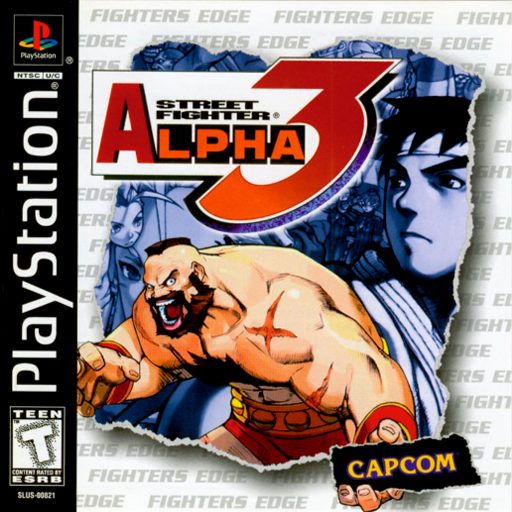
THE TWO COVERS
Zero in Japan, Alpha in America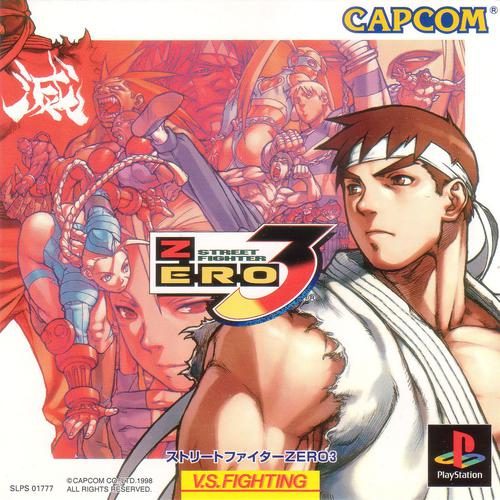
THE RELEASE
Arcade first, then everywhereThe arcade game launched in Japan on 15 July 1998, and Game Machine's 1 September 1998 issue listed it as the second most successful arcade game of the month in Japan. The PlayStation port followed in Japan on 23 December 1998, reaching North America on 5 May 1999 and Europe on 25 June 1999.
The port was a rebuild in places, not a straight dump. To free memory for character animation on the PlayStation, Capcom replaced the hit sprites with hit polygons, and the machine's RAM limited the Dramatic Battle mode's full campaigns to two fixed pairings, Ryu and Ken or Juli and Juni. In return the home version added the World Tour mode and six playable characters the arcade did not have, covered on its own page in this wing.
Then the game refused to stop. A Dreamcast version, Saikyo Dojo, arrived in 1999 with a revised World Tour and online score posting. A Japan only Saturn version the same year used Sega's 4MB RAM cartridge to restore animation frames. In 2001 the home additions flowed back into the arcade as Street Fighter Zero 3 Upper on Sega's NAOMI hardware. Game Boy Advance followed in 2002, and the PSP version, Alpha 3 MAX, in 2006, adding Ingrid to reach 39 playable characters.
HOW IT WAS RECEIVED
The PlayStation scoresWHAT IT LEFT BEHIND
The maximalist templateAlpha 3 closed its series by refusing to choose: three systems per character, the biggest roster Capcom had ever shipped, and a home version designed to exceed the arcade instead of approximating it. Its World Tour character building, level ups, unlockable fighters earned through a single player campaign, pointed at where fighting game home releases were heading.
The game has stayed in print in spirit ever since: the Street Fighter Alpha Anthology on PlayStation 2 in 2006, an arcade perfect inclusion in the Street Fighter 30th Anniversary Collection in 2018, and the Upper version in Capcom Fighting Collection 2 in 2025. Game Informer ranked it the 18th best fighting game of all time in 2019.