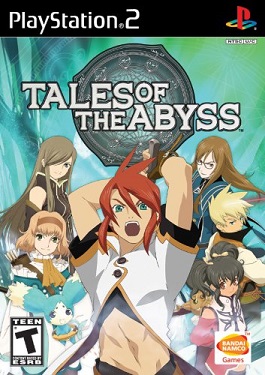
The History of Tales of the Abyss
Tales of the Abyss (PlayStation 2, 2005) was built as a celebration: the eighth main entry in the Tales series, released for the series' tenth anniversary, with the team behind Tales of Symphonia and character designs by Kousuke Fujishima. Namco gave it one of the series' characteristic genre names, To Know the Meaning of One's Birth RPG, and the game earns it: a pampered noble, a prophecy that has scripted the world for thousands of years, and a hero who turns out to be a copy of somebody else.
THE MAKING
The Symphonia team, and a system rescuedAbyss was directed by Yoshito Higuchi, who had directed Tales of Symphonia and previously worked on Namco's Tekken and Soulcalibur teams, and produced by Makoto Yoshizumi, with a script by Takumi Miyajima and music by series composers Motoi Sakuraba and Shinji Tamura. The Japanese opening theme, Karma, was performed by Bump of Chicken; licensing kept the vocal version out of the Western release, which uses the instrumental instead.
Its signature battle system began as a rescue. Free Run, the ability to run anywhere on the battlefield instead of along a line, was originally designed for Symphonia and cut mid development because players could exploit the enemy AI with it. Higuchi has explained that Abyss avoided the problem by designing the whole battle system around Free Run from the beginning, and that the Field of Fonons was added to make positioning matter: in his words, the team needed battle positioning to play a more important role if players were going to use Free Run at all.
THE DESIGN
Fonons, replicas, and the ScoreAuldrant runs on fonons, particles of sound, earth, wind, water, fire, light, and a seventh, sound itself, whose discovery let one prophet, Yulia Jue, read the future. Her prophecy, the Score, has bound the world's choices ever since, and nations have fought wars over its fragments. Into that scripted world steps Luke fon Fabre, a sheltered heir with amnesia, who learns partway through the story that he is a replica, a fomicry copy of the real Luke, Asch. The game's long second half is Luke deciding what a copy's life is worth, which is the anniversary genre name made literal.
Battles run in real time on the Flex Range Linear Motion Battle System, with four characters, cooperative multiplayer, and the Field of Fonons: elemental techniques leave charged circles on the ground, and a matching skill used inside one upgrades into a stronger FOF change. Characters learn AD Skills through Capacity Cores, spend Over Limit on Mystic Artes, and between fights the series furniture returns: skits, cooking, titles that change stats and costumes, and Grade to spend on a second run.
THE EDITIONS
Two regions on PS2, a third on 3DSTHE RECEPTION
A Platinum score, and a slow plot argumentTHE LEGACY
734,000 copies, and a European second lifeThe PlayStation 2 version sold 440,225 copies in Japan by the end of 2005, passed 556,000 there by the end of 2006, and reached approximately 734,000 copies worldwide by December 2007. A 26 episode anime adaptation aired in Japan from October 2008 to March 2009, alongside three manga versions.
Its strangest afterlife was European. The 3DS port sold past Namco Bandai's expectations in Europe and was reprinted, in a company representative's words, three or four times to meet demand, a result the publisher said made it reconsider localizing more Tales games for the West. In 2012 Game Informer named Jade Curtiss and Tear Grants among the best characters in the Tales series. No later remaster appears in the documented record opened for this page: the PlayStation 2 original and the 3DS port remain the game's two homes.
THE GAME ON THE SHELF
Tales of the Abyss · PS2