
The History of Tekken 3
Tekken 3 is a 1997 fighting game developed and published by Namco, the third entry in the series and the first built on the Namco System 12 arcade hardware. Set nineteen years after Tekken 2, it replaced most of the cast, led by new protagonist Jin Kazama, and gave every fighter a sidestep for the first time.
Ported to the PlayStation in 1998 with two whole extra modes and two hidden characters the arcade never had, it became one of the best reviewed and best selling games on the console: 8.36 million copies, according to series producer Katsuhiro Harada.
HOW IT WAS MADE
Namco, 1996 to 1997Tekken 3 was built by a team that had nearly fallen apart. Director Katsuhiro Harada has described how, during Tekken 2, rival companies were hiring aggressively across the Japanese industry and many Tekken staff left Namco. Harada created a new position for himself, Game Director, and pitched a rebuild: fix the fighting engine from scratch, change the cast, and start the series over in spirit. Eurogamer's later interview with Harada adds that Tekken 3 was made almost from scratch with the staff who remained, and that it was the first Tekken he directed.
The game was the first in the series built for Namco's System 12 arcade board, a step up from the PlayStation based System 11 of the first two games. Animation was created with motion capture at a time when optical capture was still immature. Harada recalls capturing real martial artists, including Embu demonstration world champion Hwang Su, whose Taekwondo forms became the arcade attract sequence for newcomer Hwoarang.
Set nineteen years after Tekken 2, the game kept only seven returning fighters and built the rest of the cast new: Jin Kazama, Ling Xiaoyu, Eddy Gordo, Hwoarang, Bryan Fury, Julia Chang and Mokujin among them. Artist Yoshinari Mizushima, recruited from art college, designed Jin and Xiaoyu. The developers dropped the sub boss structure of the earlier games to deepen the core roster's move sets instead. Every fighter gained a sidestep, reversals became universal, jumps were lowered, and juggle combos expanded. Sound director Nobuyoshi Sano, composing with Keiichi Okabe, pushed a big beat direction that Harada initially did not understand and then entrusted to him completely.
THE TWO COVERS
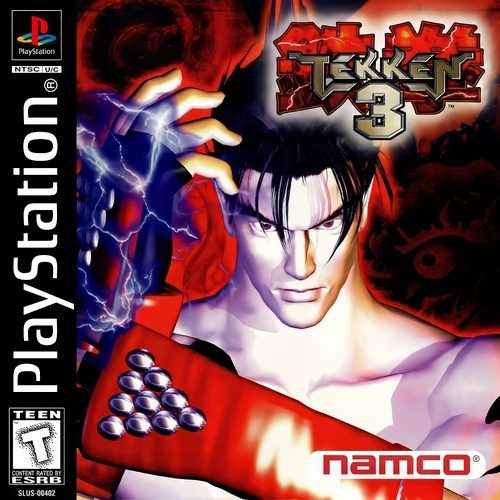
Same Jin, two packages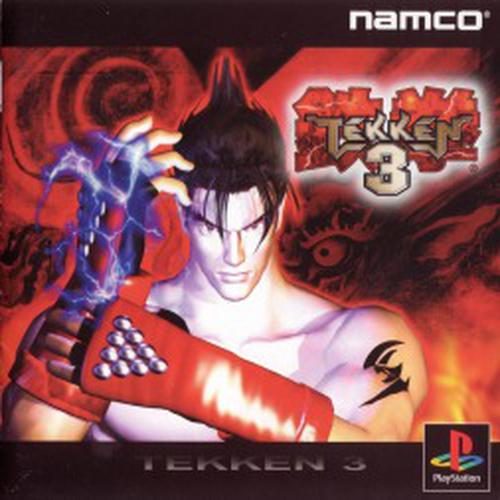
THE RELEASE
Arcade 1997, PlayStation 1998After a limited Japanese appearance in late November 1996, Tekken 3 released widely in arcades in March 1997. Game Machine listed it as Japan's most successful arcade game of the month in its 15 April 1997 issue, it became the highest grossing arcade PCB game of 1997 in Japan, and it sold 35,000 arcade units worldwide, 15,000 in Japan and 20,000 overseas.
The PlayStation conversion took eight months, far longer than the earlier ports, because System 12 was not built on PlayStation hardware the way System 11 had been. Namco representatives had originally said they did not think the conversion was possible. Harada describes compressing the arcade game to roughly 8 to 15 percent of its data: backgrounds became 2D panoramic images, character polygon counts dropped, and the resolution lowered. In exchange, the home version gained the side scrolling Tekken Force mode, the Tekken Ball beach volleyball mode, which Harada says began as a failed attempt at an aerial combo training mode, two hidden characters in Gon and Dr. Bosconovitch, and Anna Williams promoted from a palette swap to a distinct fighter with her own moves, voice and ending.
The PlayStation version launched in Japan on 26 March 1998, in North America on 1 May 1998, and in Europe on 12 September 1998. Namco sponsored a Tekken 3 tournament across Japan and the United States, with the two national champions meeting in a final at E3 1998.
HOW IT WAS RECEIVED
The scoresTHE SALES
Documented figuresIn Japan the PlayStation version sold over one million copies on its first day, and Sony gave it a Platinum Prize in May 1998 for passing one million units there. Weekly Famitsu counted 1.13 million Japanese copies in the first half of 1998 alone, the country's third best selling game of that period. In the United States, PC Data reported 1.11 million copies and 48.5 million dollars of revenue in 1998, making it the third best selling PlayStation release of the year in America.
The lifetime figure comes from Harada himself: 8.36 million PlayStation copies in the game's initial release, split into 1.4 million in Japan and 6.96 million overseas. That total makes Tekken 3 the fifth best selling PlayStation game ever released.
WHAT IT LEFT BEHIND
The templateTekken 3 set the expectation that a home fighting game should be bigger than its arcade original. Harada has said that Namco's practice of fleshing out the PlayStation ports with extra modes and content became a staple of what players expect from a consumer port, and Tekken Force was expanded on in Tekken 4 and succeeded by the Devil Within campaign in Tekken 5. The series continued with Tekken Tag Tournament in 1999 and Tekken 4 in 2001.
The game itself kept returning. The arcade version was included inside Tekken 5 on PlayStation 2, and the PlayStation version was one of the 20 games built into Sony's PlayStation Classic in December 2018. PlayStation: The Official Magazine wrote in 2009 that Tekken 3 "is still widely considered one of the finest fighting games of all time," Complex ranked it the fourth best fighting game ever in 2011, and GamesRadar placed it 59th on its best games of all time list in 2015.