
The History of Treasure Hunter G
Treasure Hunter G (Super Famicom, May 24, 1996) is a tactical RPG of four treasure hunters, Red, Blue, Rain, and Ponga, chasing the Dark King who was sealed away until a treasure hunter’s greed released him, and the Bone Dino he means to revive. It was developed by Sting, the studio’s first game, directed by Kazunari Yonemitsu, produced by Shinji Hashimoto, and published by Square. It was the last game Square published for the Super Famicom, and it was released only in Japan. Its look came from pre-rendered 3D models, and its score from seven composers at once.
THE BOX
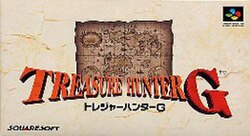
No Western box exists and none is substituted here. The staged file is 250px wide, below the Library’s working standard, and is a swap-in upgrade when a larger scan is verified.
THE MAKING
A new studio, an old machine, a new lookSting was a new developer, and this was its first production, made under contract for Square at the very end of the Super Famicom’s life. The character sprites were pre-rendered from 3D models rather than drawn by hand, the technique of Super Mario RPG and Donkey Kong Country, and it bought a practical advantage: sprites could be produced quickly in eight directions instead of the usual four, giving the little hunters an unusual freedom of movement for the system. Adventure play follows the Square house style of its shelf mates Chrono Trigger and Seiken Densetsu 3, towns, forests, dungeons, and castles, before the grid takes over.
THE DESIGN
Action Points on a gridCombat plays on a grid in the manner of the Shining Force series, governed by Action Points: moving, fighting, casting, using items, springing special attacks, and setting traps each cost points, and the terrain itself charges for the crossing, so position is a budget. A character who starts a turn beside an enemy can strike repeatedly; a character who spends everything walking arrives with nothing left to spend. Action Points grow over the course of the game, widening the tactics as it goes. Enemies are visible in the field before battle, in the Chrono Trigger manner, and quick players can sometimes avoid the encounter entirely.
THE MUSIC
Seven composers, one Sting SymphonyThe score was created collectively by the seven composers of the Sting Symphony: Hitoshi Sakimoto, Masaharu Iwata, Mitsuhito Tanaka, Toshiaki Sakoda, Yoko Takada, Tomoko Matsui, and Akiko Goto. Sakimoto and Iwata, veterans of the Ogre Battle scores, give the game its orchestral weight. The soundtrack ran to 86 songs and was published by NTT Publishing on June 9, 1996, a large musical estate for a first game by a small studio on a dying system.
THE EDITIONS
One release, one digital return, one fan translationTHE RECEPTION
Strong scores for a farewellTHE LEGACY
A first and a last, in one cartridgeFew cartridges hold two opposite records. Treasure Hunter G is both Sting’s first game, the start of a studio that would build a long career in tactical RPGs, and the final Super Famicom title Square published, closing the catalogue that had defined the company’s rise. The distinction between Square’s last published and last developed game for the system is untangled on this shelf’s question page.